Consistency and convictions – the struggle is real!

By David A. Liapis

Consistency is probably my biggest struggle as a Christian, husband, father, and as a person in general. I’m talking about consistency in emotion, character, conduct, attitude and relationships. Anyone else know what I’m talking about? I feel like a sprinter who excels in bursts with sometimes unpredictable fits and starts rather than a marathon runner who maintains a steady, deliberate pace. It can be the Jekyll and Hyde of my anger (mostly when driving) or the regularity of time with the Lord in prayer and Bible reading. In some cases, it’s more related to convictions and to what extent I apply them to life. But, before I go any further with this last thought…

The Bible is the very word of the Creator God who made us, the world and all that’s in it. God’s word contains everything we need to know for life and salvation, and it is the standard of objective truth regardless of what anyone thinks or wishes. When we deviate from God’s word, as Adam and Eve did, the results are sin, separation and death. We have been given a glimpse into the character of God in the pages of this book, and we are given one command that’s both an absolute necessity and absolute impossibility to obey on our own: “Be holy as I am holy.” However, those who know the Gospel of Jesus Christ revel in the fact that we can be declared holy not because of our own good works or self-righteousness, but because of the perfection of Christ imputed to us through the act of justification. God justifies us, or declares us righteous, not because we are actually holy in thought, deed or word, but because Christ, fully man yet fully God, lived the sinless life we could not and bore the punishment for our sin on the cross so we don’t have to. That’s the glorious message of the Gospel, without which, the Bible teaches, we are destined for eternal punishment in the Lake of Fire – which we all deserve for our rebellion against the Holy God.

So, if we are not saved because of our good works, and we have Christ’s righteousness imputed to us, why should we be worried about striving to live holy lives? Is there not abundant grace to cover our sins? Paul the Apostle addresses this very question in Romans chapter six. He says, “What shall we say then? Are we to continue in sin that grace may abound? By no means! How can we who died to sin still live in it?” There is clearly a tension then between faith and works (as we see in Romans and James) that Christians must find. There is a call to holiness that we ignore to our peril, and a yoke and burden that are “easy” and “light” that Jesus calls us to bear. Our works, even the “work” of exercising faith, is not that which saves us. Salvation is God’s work from beginning to end. If it depended on us even a little, there would be no hope for us.

With that in mind, let’s get back to my original thoughts about consistency. Let me warn you before you read any farther that I’m getting into some areas where there’s much divergence and levels of conviction among many Christians, and I am not trying to come across “judgy” or preachy. I’m not the Holy Spirit. Ok, that said, I have been contemplating some verses lately that I see as relating to what I watch and listen to – essentially entertainment – as it pertains to my obedience to the command to be holy. Here are some of the key verses:

“Turn my eyes from looking at worthless things; and give me life in your ways.”  Psalm 119:37

“I will not set before my eyes anything that is worthless. I hate the work of those who fall away; it shall not cling to me.” Psalm 101:3

“Whoever works his land will have plenty of bread, but he who follows worthless pursuits lacks sense.” Proverbs 12:11

“Whoever works his land will have plenty of bread, but he who follows worthless pursuits will have plenty of poverty.” Proverbs 28:19

“Thus says the LORD: ‘What wrong did your fathers find in me that they went far from me, and went after worthlessness, and became worthless?’” Jeremiah 2:5

What am I to do with these verses? Does this mean I need to purge my movie and music collections? Does this mean I should only consume faith-based entertainment and stop playing games on my phone? Are Jason Bourne (violence and language), Lord of the Rings and Disney (sorcery and magic), Country music (drunkenness and immorality) and most cartoon movies (crude humor) out? Am I relegated to Kirk Cameron movies, the God’s Not Dead anthology and Newsboys? Does this mean I need to forget all the guitar licks and song lyrics to all secular music I’ve learned over the years? How far do I take this? What would it look like if I took it beyond just what media I consume? If I really live my convictions to their fullest extent, would that mean boycotting all kinds of companies such as Amazon, Apple, Disney and Toyota because they support things I don’t? Should I toss my Apple devices, sell my stock, stuff my savings in my mattress and stop driving? How do I avoid becoming “worthless,” and how do I live “unspotted from the world”?

I wish I had this all figured out. The truth is, I have a lot to learn and I’m still unsettled on most of these questions. I’ve run the gamut over the years in my attempts to do what I believe(d) to be right from not celebrating Christmas like most people to multiple purges (and then some reacquisitions) of certain movies and music. Regardless of what the “worthless” flavor of the week may be, the question I need to reckon with is this: why am I doing/not doing X or Y? Is it because I am falling into the trap of trying to earn God’s favor through attempted self-righteousness or piety, or is it because something is truly “sin that so easily ensnares” me that needs to be shed and left for dead so I can run the race of faith better and “be holy” as God is holy?

I truly want to have a better conclusion for you. I would like to say, “And now, here are the answers to all the questions above…” but I cannot. I think there are two key factors at play here. The first is that there is intentional ambiguity in the Christian walk that’s meant to drive us to prayer and seeking God’s wisdom in the Bible. The second is that there are things we find in the Bible in those times of seeking that we don’t want to confess mean what we find them to mean. In other words, we lack the faith to act on convictions to rid our lives of certain things. We love the world and things in it and resist the call to be separated from those things. We justify them, we try to ignore the call to change, and when we do that, we become numb and callous to the Holy Spirit. This has happened to me more times than I’d like to admit. What’s the solution? Trust and obey. Trust that God has something far better for us in the life to come, and obey the Holy Spirit’s leading no matter how big or small the matter. When we do this, we can join Paul the Apostle in setting our minds on things above and counting all the things below as rubbish in order to gain the joy of Christ.

War and peace

By David A. Liapis

Thoughts on Matthew 5:38-42

The Law that was given to the people of Israel through Moses contained not only dictates and prescriptions related to the Jewish religion (ceremonial, dietary, purification, sexuality, etc.), but also legal matters. Numerous scenarios were presented along with resolutions intended to settle the matters and cause “others to fear” in order to prevent future infractions. However, the overarching theme of all the legal laws pointed to one thing – the holy standard by which God called his people to live. Much of the law was given in relation to negative consequences, as in “if you do this to someone, then this will happen to you” or put another way “do to someone as they have done to you.” This, of course, sounds similar – yet not – to a familiar quote from Jesus (Luke 6:31), “And as you wish that others would do to you, do so to them” which is a way to seek positive consequences from the ways in which we interact with others. Luke summarizes in half a chapter what Matthew takes three chapters to detail, and places the “Golden Rule” at the end of a paragraph about turning the other cheek, loving one’s enemies and giving to those who beg from you. This distillation of Jesus’ sermon on the mount makes these commands come across as more proverbial than the way Matthew’s account does, wherein Jesus continues to tie in these commands with his “You have heard it said…” statements.

What’s important about the way Matthew presents this passage is how it’s tied to legal requirements in the Law versus something that’s simply relational. If this were unrelated to legal codes, then it could be reasonably argued that strict pacifism is demanded here. It could be interpreted that we are to never resist an evil person, but rather to let them defraud, steal, rape or kill without being confronted. I admit this passage has given me pause a number of times as I have considered things such as military service and carrying a concealed weapon. Does this passage prohibit me as a Christian from defending myself and others? If someone were to try to kidnap one of my children or rape my wife, should I not resist them?

Jesus uses hyperbolic language in places, such as when he said it’s better to pluck out an eye or cut off a hand in order to avoid sin (see post about verses 5:27-30). Is this how he means this as well? I don’t think so, yet I also don’t think he’s advocating for letting unopposed harm be done to people. Since Jesus has been getting at the spirit of the law versus the letter of law thus far in this sermon, it seems to me that he is telling us to avoid a vengeful spirit and and to be willing to accept a wrong done to us. This is how we can love our enemies and seek to be peacemakers. Some really practical applications for me are when I’m driving or standing in line for something and someone cuts in front of me or takes my turn. How do I respond? With anger and indignation because I’ve been slighted, or by “turning the other cheek” and crushing the prideful attitude that wells up in my heart? Or how about if someone defrauds me? Do I seek to forcefully take back what it mine and despise the defrauder in my heart for their wrong against me, or do I let it be and have a willingness to give them my “cloak” as well? As petty as some of these things may seem, the struggle is real!

As always, Jesus is after our hearts. How we respond to being wronged reveals what’s inside us. If we’re walking in the Spirit, we’ll have an easier time knowing how to react to the various situations we encounter. We need to seek the Lord’s wisdom to know when to make peace and when to make “war” against sin and evil – and this applies from the smallest slight to an individual to full-scale wars between nations. God’s people have been forced to make these kinds of decisions and choose how to react since the beginning from Joseph to Daniel to Paul to Martin Luther to Bonhoeffer to Christians serving in the militaries of nations around the world. I wish there was a clear, black and white answer to every situation, but there’s not. King David wrote in the Psalms about ridding his kingdom of the unjust and wicked using the sword. Jesus warned Peter that those who live by the sword will die by the sword and was willing to suffer the most unjust and horrible treatment in silence “as a lamb.” There are many passages that could be used to support just about any point on the spectrum between all out war and pacifism. It’s up to us to be in prayer and seek wisdom about our situations and how we can honor God and love our neighbors by how we respond.

Call me Christian

By David A. Liapis

It was during a recent sermon I was hit with the question of whether or not I am willing to be named among God’s people, no matter the cost. The sermon was in relation to Queen Esther, who, as we know from the book in the Bible named after her, was faced with a choice to either risk her life by breaking laws of formality by going before the king un-summoned to plead the cause of her people, or to refrain from being an advocate for the Jews and hope to survive the impending genocide inside the walls of the palace. Of course, Esther chose to risk her life in order to at least attempt to save her people from the evil that was to befall them at the hands of Haman the Agagite and all who obeyed the edict to annihilate the Jews from the face of the earth. To this day, Esther is celebrated as the one who was placed in the palace “for such a time as this” and, by the unseen providence of the God of Israel, succeeded in thwarting the plans of Haman and bringing calamity upon him and those who hated the Jews.

The question raised about my willingness to risk being “put out of the palace” for being counted as one of God’s people was convicting. There have been times where the fear of man and self-preservation (of my career) have resulted in my silence or avoidance of certain situations and topics. While it’s true we are to be as wise as serpents and harmless as doves, there have been times when I used that as an excuse to let “relief and deliverance” arise from “from another place.” In other words, I chickened out because I was afraid I’d lose my job if I refused to hide my convictions, or, as my employer terms them, “deeply held religious beliefs.” There are many examples of people getting steamrolled by the progressive agenda from cake bakers to photographers to military commanders and even chaplains. These are real examples of real people who have given up their reputations and livelihoods to stand for what they believe – to be counted among God’s people. Of course, these are “first world problems” compared to the persecution and martyrdom Christians are suffering in other parts of the world.

The most maddening thing about this is that real Christians – those who truly understand certain truths I will lay out momentarily – are the least threatening, most understanding people who should be embraced, not crushed, by those who disagree with them. But, there are two reasons why this cannot be so. First and foremost is the fact the darkness will always hate the light since light exposes what the darkness wants to hide. This is Biblical truth supported by more than six thousand years of empirical evidence. The second, which is closely related to the first, is that there is no room for disagreement anymore in America, just opposition and hostility. We have lost the ability to “agree to disagree” with each other. Now, just because I believe certain things, such as in the traditional definition of marriage and binary gender identity, I am labeled as a “phobic” and “hater” of things I don’t embrace or celebrate. I am no longer allowed by our society to believe an action or lifestyle is unhealthy, unnatural or sinful.

That last paragraph may seem like a digression from my main point, but it’s not. The paradox of the Christian life is learning how to be in a culture and love the people therein, yet remain unstained by the sins of that culture and call sin what it is, even if it’s unpopular and might land you in court or in the unemployment line. The following Christian truths are paradoxical as well. They are the most equalizing realities, yet create the most polarization because they are based on premises most people reject. Believe them or not, here they are:

  1. We are all equally valuable because we’re made in the image and likeness of God. The lies of humanism and evolution have resulted in a society where life is devalued and people of all colors, cultures and creeds are not given the respect and dignity they should have. This includes all people, no matter what they believe about religion, sexuality, gender, etc. I would also add state of gestation.
  2. We are all equally depraved and sinful. I’m a sinner, you’re a sinner. We’re all sinners. It just takes different forms for each of us. For some it’s adultery or drunkenness, for others it’s sexual immorality/perversion or anger, while for others it’s pride (including pride in self-righteousness, religion, status or morality) or any number of other sins. Just because I believe something to be sinful (using the Bible as the sole basis for this definition) does not mean I hate, detest, fear, or even judge the person sinning. God is the ultimate judge – and he will judge according to his standard, not mine, nor that of any person or culture. If that’s true (and I believe it is), then the most loving thing I can do is to tell people they are depraved sinners in need of a Savior in order to escape the impending judgment and wrath of God.
  3. We are all equally offered salvation from our sins. Christians are saved sinners, and they are called to share with all people the message of salvation through faith alone in Jesus Christ. The Bible teaches that there is “no partiality” with God. All people are held to the same standard, and salvation is made possible for every person for whom Christ died. We don’t know who will be saved, so we go and we preach and we love all people from every nation, culture, orientation and belief system. The Bible is explicitly clear that the good news of Salvation through Jesus Christ is for all kinds of people.

What does this all mean? It means that Christians who are named among the people of God are called to live their lives in accordance with God’s word, to love others and to not tolerate or celebrate sin in their own lives, the lives others or in the culture/society in which they live. This means a true Christian might not bake cake or agree to photograph a wedding if they disagree with someone’s lifestyle choice, but it simultaneously means they will also love them and seek to share the Gospel of Jesus Christ with them. It does not mean they hate, fear or seek to harm them in any way.

I, for one, desire to be named among the people of God no matter the cost. I’m sure this blog post will be dug up someday in order to prove that I’m some kind of narrow-minded, homophobic, sexist, bigoted, misogynistic racist who stands opposed to all that is right and good in a progressive and liberal world. Although I am none of those things in the least, I will accept the risk of being labeled as such by our culture. I would rather be named with the people of God and lose everything in this life – and even my life, if necessary – to gain Christ. In the words of Esther, “If I perish, I perish.” To perish in this life is but the gateway to true life in heaven. To live this life not among the people of God is to perish in the next life, and that for all eternity.

“For I am not ashamed of the gospel, for it is the power of God for salvation to everyone who believes…” Romans 1:16


Don’t politicize Jesus

By David A. Liapis

I was quite surprised to read an op-ed today on CNN.com by Jay Parini entitled Paul Ryan’s firing of Father Conroy should worry us all not because of it’s obvious anti-Republican bias, but rather because the author openly claims to be a Christian and was still allowed to publish his thoughts. I will say I agree with Parini in his condemnation of the “Prosperity Gospel” and the damage it has done to Christianity. Anyone who gauges their standing with God based on the quality of their health and wealth is likely not in possession of an orthodox understanding of the Gospel. I also share concerns that the House chaplaincy has seemingly become embroiled in a political skirmish. I don’t know all the details of that, nor is that the issue that really concerns me.

What really concerns me is the fact Parini attempts to politicize Jesus Christ, even in the midst of an op-ed condemning the politicization of the House chaplaincy. Parini says, “Christianity is the religion of Jesus, who was himself ‘political’ in that he took sides with the poor, the ill and those who lived on the margins.” There’s nothing political about loving the poor, the sick and the “sinners and tax collectors.” What Parini seems to be trying to imply is that Jesus would have been a progressive/Democrat versus a Republican because he cared about the poor and needy. He’s implying that Republicans, Christian or not, are all wealthy, greedy and care nothing for those “below” them, and that they revel in a health, wealth and prosperity gospel that affirms their self-righteous “smugness.” While there are unfortunately a few people who fit this description, they do not, and should not, represent conservative Christians as a whole.

I have moved among conservative Christian circles all my life, and I can say with a reasonable amount of credibility that most of the people I have known and been acquainted with seek to follow Jesus’ commands to love God and love others. Lest you assume I am unqualified to make this assertion, let me say that I have attended scores of churches, chapels and Bible studies in more than a dozen states and four countries. I have also known some of the most un-Christian people in my travels and jobs – the people Christians are called to love – and so have not lived an insulated, sheltered life speaking in an echo chamber or caught up in a perpetual “holy huddle” with like-minded Christians. Rather, my life experiences have taught me many things about politics and religion, two of which I want to highlight.

First, God’s people, aka the Church or “body of Christ,” are all over this wide world loving God and loving others. There’s nothing more encouraging than being able to travel just about anywhere and find pockets of people who really get it and who are really trying to build communities around the Gospel of Jesus Christ. The second thing is that there is persistent and harmful mischaracterization and misperception of genuine Christians that’s propagated mostly by Hollywood, the media and academia.

Parini’s op-ed certainly does nothing to fix this issue, but rather encourages more division – not based on the genuineness of someone’s faith claims, but on how they vote. He fails to acknowledge the millions of conservative Christians who, though they may not vote Democrat or support all the government-funded welfare and assistance programs, love the poor, the sick and outsiders; and they do so by sharing with them the hope of salvation through Jesus Christ and by acts of service and the giving of millions of dollars and volunteer hours to charities and ministries that help the very people Parini accuses them of ignoring by voting Republican.

This is not intended to be a politically focused op-ed. I really don’t care how someone identifies politically. I really don’t care that Parini assumes conservative Christians can’t truly claim to follow Jesus Christ. In the end, opinions and political affiliations will not matter one bit. All that will matter when the trumpet sounds and Jesus appears in his glory to judge the living and the dead is whether we know him, and he knows us. But, until that day, I plead with everyone who claims the name of “Christian” – regardless of political persuasion – to be busy about loving God and loving others lest the mischaracterizations and misperceptions become prophetic.


I swear to God!

By David A. Liapis

Thoughts on Matthew 5:33-37

This passage has been taken by some to mean we should never take any kind of oath ever, which, at first glance may seem like a reasonable interpretation. However, most commentators agree this is not a blanket prohibition on taking oaths. In fact, we read about Paul and angels taking or swearing oaths in other place in the New Testament. If all oaths were wrong, then everyone of us who has taken an oath of office, whether military, political, judicial or otherwise, has violated Jesus’ command – if it means to never swear an oath in any circumstance.

I could reference various commentaries and provide a summary of their contents, but I will not. While doing so would reveal a more robust historical context and explanation of how Jews of that day were twisting and manipulating truth by using different “levels” of oaths based on what was being sworn by, I think the passage speaks adequately for itself. That being said, I encourage you to search out where this was “said of old,” what it meant then and how it was being abused in Jesus’ day.

When I was young (and unsaved), I would “swear to God” when I really wanted someone to believe what I was saying, even if it was a flat out lie. I would try to leverage an oath to convince someone of the truthfulness of my claim or statement. Here’s an example of the escalated oath taking – Me: “Dude, my grandpa has a million dollars!” Buddy: “Shut up. You’re lying.” Me: “Unh-uh. I swear it.” Buddy: “No way! You’re a liar.” Me: “I swear to God! He has the money!” Buddy: “Wow! That’s awesome. How much does he give you for your birthday?”

You get the idea. Sometimes the lie would work (usually when the claim could not be verified), but usually the lie would be discovered and the “swear to God” would lose its effect on that friend. Is that a blatant form of taking the Lord’s name in vain? Yes. Is that lie? Absolutely. Two of the Ten Commandments broken just like that. In addition to the sin, there was also lost credibility and the degradation of my character.

I believe Jesus’ goal in this passage is to reveal not only how to avoid sinning against the Lord, but also how to become people marked by honesty and integrity. He said, “Let what you say be simply ‘Yes’ or ‘No’; anything more than this comes from evil.” We should be the kind of people who are honest so consistently that when we say “yes” or “no,” there’s no need to escalate on the “swear scale” in order to convince someone of the validity of our statement or claim. If we’re always truthful, we avoid evil. If we’re always truthful, even if it hurts us or brings shame upon us, we avoid evil. If we are known as people of their word, not only do we avoid evil, but we honor God and bring glory to His name.

I’ll close with the words of Paul from Colossians 3:9-10: “Do not lie to one another, seeing that you have put off the old self with its practices and have put on the new self, which is being renewed in knowledge after the image of its creator.”

The sacredness of sex

By David A. Liapis

This is sort of a sequel to my previous blog post about Matthew 5:31-32.

“One flesh” is used many times in both the Old and New Testaments to describe the marriage bond between a man and a woman. It’s first used in Genesis, and Paul and Jesus both make use of it as well multiple times. While it’s figuratively descriptive of the emotional and spiritual closeness of the marriage relationship, it most directly refers to the “oneness” of the physical act of sex. However, the physical act can by no means to be divorced from the emotional and spiritual elements of sexual intercourse. God designed it to be that way, and that is why when we deviate from that or try to ignore it, the result is pain, dysfunction and brokenness.

One of the foremost issues as it relates to this topic is that our culture tries to portray sex as a purely physical act that can also have emotions attached, but that it’s okay if they’re not. Furthermore, our culture rarely connects the spiritual element, except in the cases of certain cults and religions. However, the Bible makes it abundantly clear that sex is physical, emotional and spiritual. Read Romans chapter one and you will see very clearly a negative example of this reality. In fact, the sexual perversion Paul discusses there is the ultimate outworking of the rejection of the knowledge of God and the suppression of the truth in unrighteousness. What’s more is that sex was actually that which consummated and established marriage in the Bible, not a lavish ceremony with vows like we have today. That’s why Paul says in 1 Corinthians 6:16, “Or do you not know that he who is joined to a prostitute becomes one body with her? For, as it is written, ‘The two will become one flesh.’”

What does this mean for us? This means that we need to have a Biblical view of sex in order to fully celebrate it and protect it. It means we need to view sex as more than just a physical act, but also one that is intended to unite body, heart and spirit between two people. It means that there’s a reason why such confusion, emptiness and shame are experienced by so many who engage in sexual encounters that our culture tells them are good and natural. It means that more grace and forgiveness will be required in relationships weighed down with the self-inflicted scars of a sexually active past. It means we need more than ever to teach our children that sex is sacred and belongs strictly within the bounds of a committed marriage relationship.

Many pages have been written on consequences of a sexually promiscuous culture that include the emotional toll (especially on women), the rampant spread of sexually transmitted diseases and, more tragically, the breakdown of the family unit and the abortion, rather murder, of millions of unwanted, unborn babies. God created sex, so it is a good thing. He could have made the act of procreation painful or completely uninteresting, but He didn’t. Rather, He gave us a sacred gift that is intended to be enjoyed within the context of marriage that can be one of the most pleasing, fulfilling experiences in life. Here’s a secret: married, monogamous sex – that which so many reject as old fashioned, restrictive and unfulfilling – is actually more freeing, fulfilling and satisfying that they can imagine. I’d say the jokes on them, but this is no joking matter.

I will close these words from Galatians 6:7 – “Do not be deceived: God is not mocked, for whatever one sows, that will he also reap.” (ESV)

…Let not man separate

By David A. Liapis

In order to have a proper understanding of divorce, you must first have a proper understanding of marriage – the first human institution created by God at the very beginning of our existence. To assert that marriage is a lifelong bond between a man a woman is not a political, social or cultural statement. It’s simply stating the facts as they are presented in Genesis and the rest of the Bible. Genesis says that God created “male and female” in His own image (1:27), and that He blessed them and commanded them to “be fruitful and multiply and fill the earth and subdue it…” (1:28). The Lord, after creating Adam and seeing that “it was not good for man to be alone,” created a “helper fit for him” – woman (2:18), made not out of the dust of the ground like Adam or the animals, but out of man (2:19-22). Adam was so pleased by Eve he exclaimed, “This is at last bone of my bone, flesh of my flesh; she shall be called Woman, because she was taken out of Man.” The next verse begins with a “therefore,” so God creating Woman from man is the reason why a man and his wife are to live together unashamed and in a unity so close they are “one flesh.” “One flesh” is such a vivid depiction of the strength of the marriage bond that is both a metaphor for sexual union (that which in God’s eyes actually consummates a marriage covenant – 1 Corinthians 6:16 says, “Or do you not know that he who is joined to a prostitute becomes one body with her? For, as it is written, ‘The two will become one flesh’) and a warning of the harm that comes from tearing a man and woman apart.

In case there’s any doubt in anyone’s mind, marriage is a big deal to God. It is within the context of marriage that God gives the first command in the Scriptures – to be fruitful and multiply, which is to have families. The author of Hebrews says to “let marriage be held in honor by all…” (13:4) and Paul the Apostle warned of those who would come in the last days and forbid marriage (1 Timothy 4:3). Proverbs 5:18, 18:22, 19:14 and 31:10 make it clear marriage is a blessing from the Lord. Consider also the words from Malachi 2:13-16:

And this second thing you do. You cover the LORD’s altar with tears, with weeping and groaning because he no longer regards the offering or accepts it with favor from your hand.

But you say, “Why does he not?” Because the LORD was witness between you and the wife of your youth, to whom you have been faithless, though she is your companion and your wife by covenant.

Did he not make them one, with a portion of the Spirit in their union? And what was the one God seeking? Godly offspring. So guard yourselves in your spirit, and let none of you be faithless to the wife of your youth.

For the man who does not love his wife but divorces her, says the LORD, the God of Israel, covers his garment with violence, says the LORD of hosts. So guard yourselves in your spirit, and do not be faithless.

Marriage is big deal to God not only because of it’s key role in promoting healthy, godly families, but also because it’s ultimately a picture of His relationship to His people in both the Old and New Testaments. God refers to Himself as the husband of the people of Israel in the language of many of the prophets and decries Israel’s unfaithfulness to Him many times. In spite of all His longsuffering and mercy, His “wife” continued to “play the whore” and remained in unrepentant unfaithfulness to God to the point where He divorced her (Isaiah 50:1 and Jeremiah 3:8). However, as shown so painfully in the life of Hosea the prophet who was directed to marry a prostitute who was unfaithful to him multiple times, God’s desire is for reconciliation and restoration of the marriage covenant. In the new Testament, the people of God – the Church – is described as the “Bride of Christ,” and the way He relates to His bride is put forth as an example for husbands to imitate (Ephesians 5:25-29). In fact, Paul states explicitly in Ephesians 5:31-33, wherein he restates Genesis 2:24, that the “mystery” of marriage is “profound” and “refers to Christ and the church.”

Again, marriage is a big deal to God. Therefore, divorce is also a big deal to God. Jesus’ condemnation of divorce in the Sermon on the Mount was not in response to a question, as it is later in Matthew 19:1-12 (and paralleled in Mark 10:1-12). He brought it up because it was important and because God’s design “from the beginning” was to not have separated that which He joined, that much is clear. What’s not so clear is how to rightly apply this passage today. Back then, “sexual immorality” was pretty straightforward. Today, we have the internet, cell phones and other mediums for sexually immoral things to take place. Some would argue that only the physical act of adultery constitutes grounds for divorce. Others would argue, even relying only on the previous verses about lust in the heart being commensurate with adultery, that viewing pornography, thinking about someone lustfully or an “emotional affair” are grounds for divorce.

This is also a difficult topic because it is so epidemic in our broader culture and in the Church, and so there is much hurt, guilt and offense to consider when dealing with it. However, we cannot and should not shy away from it because of the fact it’s so clearly important to God. There’s so much that can and should be said on this topic, but I’ll summarize with this what I believe to be the main points of Jesus word in Matthew 5 and 19, as well as God’s intent from all the other related passages:

  1. Marriage was created to be a lifelong, “one flesh,” covenant relationship between a man and a woman “from the beginning.” This is evidenced by the fact Genesis 2:24 is quoted in whole or in part five times in four different books of the Bible.
  2. Divorce, while allowed in cased of sexual immorality, is not part of God’s original design, nor is it the preferred course of action. Rather, Gospel-empowered reconciliation should be sought. Hosea 3:1 and 5 says, “And the Lord said to me, ‘Go again, love a woman who is loved by another man and is an adulteress, even as the Lord loves the children of Israel, though they turn to other gods and love cakes of raisins … Afterward the children of Israel shall return and seek the Lord their God, and David their king, and they shall come in fear to the Lord and to his goodness in the latter days.”
  3. We should not, like the Pharisees, seek the “easy way out” of marriage as it suits us. My understanding is that women in those days were being divorced for such small reasons as not being good cooks. Marriage relationships are hard and take work, self-sacrifice and real love. Good feelings and gushy emotions are a plus, but are also fleeting and inconstant. Thus, it takes determination, commitment and learning selflessness to make marriage work.

Lust, etc.

By David A. Liapis

Lust is a powerful and dangerous form of covetousness. It’s the sin that led King David to take the wife of Uriah and have the loyal husband murdered. It’s the sin Paul warns Timothy not to stay and fight against, but rather to flee (2 Timothy 2:22). It’s the sin Peter says wages war against our souls (1 Peter 2:11) and that James tells us “brings forth death” (James 1:15). It’s a sin that will be “especially” punished by God (2 Peter 2:9-10) when the end comes. For these reasons, Jesus used hyperbolic language to describe to what extent we should go in order to avoid it – tearing out our right eye and cutting off our right hand.

Jesus obviously was not advocating for self-mutilation, but He was trying to make a strong point. He prefaced His discussion on lust with the second of seven “You have heard it said” statements in this Sermon on the Mount. It’s likely He had the seventh and tenth commandments in mind, which the Jews were keen on following – externally. However, as with the previous verses on anger and murder, Jesus turns the focus inward and reveals the spirit of the Law which broadens the condemnation.

One thought on this struck me. We could sit here and complain that we have it more difficult today with the types of potential lust-inducing people, pictures, magazine, videos, etc. that are not just available, but in our faces every day from beaches to grocery stores to highway billboards to our living rooms. It’s like we live in a huge lust trap. However, there’s a truth that we need to recognize that reveals the root of the sin isn’t culture or our surroundings. Rather, it’s this: The heart of man is desperately wicked. It didn’t matter that women in those days in that culture were mostly covered – very unlike today’s culture – and yet the sin of lust was so prevalent that Jesus and just about every other New Testament author talked about it. Why? Because the root of the issue of lust lies within our discontented, selfish, proud hearts. To give in to lust is to say to God, “I’m not content with what You have ordained for me. I know what I really need, so I’m going to get it no matter the cost. I deserve to be happy, and You’re not making me happy.” Thus, our lust not only destroys our relationships with other people, it places us in direct opposition to God. Hence the strong, repeated warnings in the Bible against this sneaky, deadly sin.

The question we have to reckon with, if we truly want to learn and live the intent of Jesus here in Matthew five, is this: What do we have to cut off and cast away in order to avoid our whole body being cast into hell? I don’t know what this may look like in your life. It may be a certain show or movie, an electronic device, finding a different route or store, avoiding the mall. Whatever “fleeing” looks like for you. However, don’t stop there. The root issue is in the heart. Removing certain temptations is only somewhat helpful. If the root of lust remains in our hearts and is not replaced with contentment and trust in God’s will, the lust will simply manifest itself in a different way. Remember, too, that since lust is really a sub-sin of covetousness, the same can be said of other manifestations of discontentment and desire for non-sexual things such as money, status, food, etc.

The Gospel of Jesus Christ and its power to free us from sin is the only real solution. If you already believe it, preach it to yourself daily and continue to repent and recognize your need for the work of Christ on the cross. Run to the cross again and again until you are freed from sin either through sanctification or death. The struggle with sin, and for some it’s “especially” lust, will be a lifelong battle. Even if it seems it’s a losing battle, take heart if you’re still fighting. Final victory is assured not because of our efforts, but because of Christ. Our continued striving is evidence we believe it.

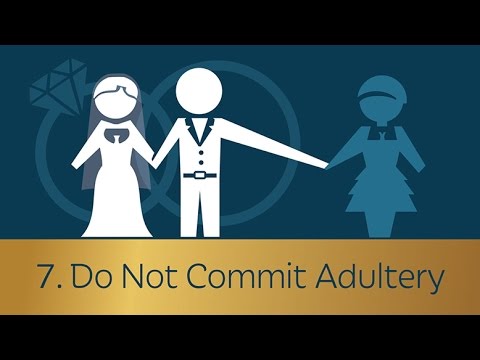
(Courtesy illustration from Prager University)

The reconciliation of X and Y

By David A. Liapis

Thoughts on Matthew 5:21-26

As discussed previously, I believe the intent of much of what Jesus says in the Sermon on the Mount is, like Romans chapters one and two, to convince us of our own depravity and need for a Savior. In the preceding verse, Jesus states that a person’s righteousness must exceed that of the Scribe and Pharisees if they want to enter the kingdom of heaven. I’m sure you’ve either heard someone say or have said yourself, “I’m pretty good. I’m not as bad as some people, like murderers and adulterers…” It’s quite likely there were those in the crowd that day who were thinking something similar. Jesus’ response in this passage is almost as if He were saying, “And in case anyone somehow thinks they are righteous enough, you have heard it said…” The major difference here is that Jesus addresses and cares about the heart of man, not necessarily what’s said or done (although those are evidences of what’s in the heart – see Matthew 15:10-20), whereas the Jews were focused on behavior that was informed and shaped by the Mosaic Law.

This behavior-focused rule keeping has been and is at the heart of religions and legal systems all over the world throughout history. We can learn how to act, how to speak and become very proficient at conforming to societal/cultural norms and expectations. However, as we are too keenly aware, the evil that’s in the heart will manifest itself someday in some way. Yet, this is how our society functions. We have laws and expected standards of behavior and all is well until someone deviates from them, and then we send them to correctional facilities in an attempt to reform their behavior. The trouble is, and as Jesus points out, the issue isn’t deviant behavior (or even the lack thereof), it’s our wicked hearts. Jeremiah tells us, “The heart is deceitful above all things, and desperately wicked: who can know it?” (17:9).

Jesus starts this portion of his sermon with, “You have heard it said” – a prefacing phrase he’ll go on to repeat seven times, connecting each topic to the Law (in this case, Leviticus 19:17). His first point addresses murder – something of which probably everyone on the crowd could claim innocence … until Jesus drives to the heart. A few sentences were all it took for the crowd to go from likely 100 percent innocence to 100 percent guilt. Who has not been angry with someone at some point, and even gone so far as to wish them harm … or worse. According to Jesus, that’s on par with committing the act itself and makes us liable to judgment.

In many instances, our “horizontal relationships” with each other affect our “vertical relationship” with God. Jesus connects the two here in this passage quite clearly. The Apostle John must have been listening closely and been impacted by this because we read in his first letter that we cannot claim to love God whom we have not seen while hating our brother whom we have seen (1 John 4:20). What’s even more convicting about this passage is that Jesus doesn’t say “If you have something against your brother,” but rather, “if your brother has something against you.” This requires more than just an awareness of how I’ve been offended or wronged. That’s easy for us. We’re all too ready to point out wrongs done to us. That’s insufficient though. Jesus calls us to seek reconciliation if someone has something against us. That has implications. It means we need to be conscious of if and how we’ve hurt or offended someone. This requires looking out from ourselves and knowing each other enough to perceive when relationships are strained.

Regardless of the cause or severity of the troubled horizontal relationship, Jesus’ point here is that our interpersonal relationships affect our worship of God. God calls all of His children to be peacemakers, reconcilers and healers of relationships. After all, those are the examples He has given to us throughout the Old Testament and, now, through the life and death of Jesus Christ. We, who were enemies and haters of God, have been reconciled to God through Jesus Christ. As John also says in 1 John 4, “We love because He first loved us.” May the love of God be made evident in our lives and in our relationships with each other.

My rights, your benefit – an open letter to anti-gunners

By David A. Liapis

Photo by Joe Pellegrino

Dear Anti-Gun American,

I’m your neighbor. I’m the guy sitting behind you at the restaurant. I’m the woman standing in line in front of you in line at the grocery store. I’m potentially every person you come in contact with on a daily basis. I’m one of 14.5 million Americans who has a license to carry a concealed weapon.

I’ve heard many people who don’t like the fact it’s our Constitutional right to own a gun say that they are terrified of guns. They hate them and don’t want anyone to own them, and especially to carry them around in public. Here’s the truth of the matter – legal carry happens all the time, and “gun-aphobes” have no idea they, according to their sentiment, should be scared. But here’s another truth – they shouldn’t be scared. In fact, they should feel safer knowing there’s a good guy with a gun in close proximity who could, if needed, potentially prevent a massacre.

I carry my gun everywhere the law allows, and I’ve never once come close to using it – and I hope I never do. But, if I’m ever in a situation where lives are at risk and there’s no law enforcement around (which is typically going to be the case for at least the first five minutes of any situation), I’m licensed, trained and practiced, and I will employ deadly force to protect myself, my family and, yes, even you – someone who wants to disarm me, infringe on my Constitutional rights and malign me for my choices. Think about that for a while.

There’s a fine balance between rights and privileges. Driving a motor vehicle is a privilege, not a right. You must be trained, licensed and insured for the safety and peace of mind of everyone around you. While I may not agree with you that everyone shouldn’t have guns, I also don’t believe everyone should carry a gun even though it’s a Constitutional right. I also feel that anyone who does should be well-trained in handling their firearm and well-acquainted with the applicable laws and the use of force.

It takes very little in the way of research to find ample evidence that states and cities (take California or Chicago for instance) with strict gun laws have higher rates of violent crime in spite of their tough gun laws. Additionally, it doesn’t take much to see, if you’re objective enough to accept the truth, that most mass shootings have occurred in “gun-free” zones.

It’s dumbfounding that so many people refuse to accept the truth that bad guys don’t care about “gun-free” zones, signs, laws or your life. Only law-abiding citizens with guns, i.e., the ones you want around when things go bad, are going to obey the law and care about your life.

Imagine a couple of scenarios if you will. Here’s the first one:

You’re in a “gun-free” restaurant enjoying a meal when someone comes in shooting. What do you do? Duck for cover? The table is too small. Escape out the nearest exit? You can’t get there without getting closer to the shooter. Pull out your phone and call the police? They will likely take at least five minutes to arrive. The shooter is aiming at you now. You’re shot. Will you survive? Will the cops clear the scene so the paramedics can come in and treat you before you bleed to death? What about the dozens of other gunshot victims? Five minutes seems like an eternity as the death toll rises until the police arrive and neutralize the shooter.

Second scenario: You’re in a gun-friendly restaurant enjoying a meal when someone comes in shooting: What do you do? The person at the table next to you quickly jumps behind a support beam, pulls out their concealed weapon, take three quick but accurate shots at the shooter, knocking them to the floor, disarms them and then puts their own gun away and waits for the police to arrive. The whole episode lasts mere seconds. You’re alive, and only one person was shot and is being given first aid by a bystander.

Neither scenario involves you possessing or even owning a gun, and I’m not trying to convince you that you should get one. The first and deadliest scenario also involves other law-abiding citizens not possessing guns because of restrictive gun policies, while the second one involves citizens trained, prepared and allowed to carry concealed weapons.

What’s the point of all this? The point is to convince you that my gun isn’t evil and that you should not fear it nor advocate for me to not be able to own or carry it. Here’s what you should be concerned with: a situation where you run into terrorists and their sympathizers, violent criminals and anyone else willing to do harm to others without you having the means to protect yourself (or having someone like me around who does).

I hope you change your mind about guns and realize good guys with guns deter bad guys with guns. But, even if you never do, I will continue to be willing to protect you and everyone else to the best of my ability so long as the laws allow me to be armed. However, if you succeed in your crusade to disarm me and other law-abiding Americans, I’ll be racing you to the nearest exit as we hope and pray the bullets of an active shooter miss us.