John and the reality of eternal judgement

By David A. Liapis

Thoughts on Matthew 3:1-12

The first thing to note is that John is the cousin of Jesus. While there are no verses that describe any pre-baptism encounters between them, it seems unlikely to me, given the prominence of family in that culture, that the two didn’t meet at some prior time. Who knows, maybe John and Jesus were hanging out together on the famous trip to Jerusalem when they were 12 years old. Luke 1:80 says of John, “And the child grew and became strong in the spirit, and he was in the wilderness until the day of his public appearance to Israel.” At what age John left home for the wilderness is not clear, but it seems it was before he was considered a man. Maybe both his parents died when he was young. After all, they were both well advanced in years when he was born.

Regardless of the time in between Luke 1:80 and Matthew 3:1, we know that John lived a strange life and began preaching in the wilderness at some point. There’s not a definite timeline given, nor is there any indication of how or why people started listening to John. Whatever the catalyst, people began seeking to hear and be baptized by this peculiar man. In Matthew 11, Jesus states John was not only a prophet, but the fulfillment of prophecy (Isaiah 40:3). And even thought he would deny it (John 1:21), Jesus contradicted him and stated that he was in fact the “Elijah” who was to come (Mark 9:11-13).

Even though John spent most of his life in the wilderness, he still knew enough to know the Pharisees and Sadducees were religious hypocrites. He called them out in front of everybody for their hypocrisy and referred to them as snakes. He even posed a counterargument to their favorite copout argument before they even rebut. He said, “And do not presume to say to yourselves, ‘We have Abraham as our father.’” He hit them hard and didn’t let up. He then proceeded to inform them that judgment had already begun and that bearing fruit in keeping with repentance was necessary to keep them from being chopped up and cast into the fire. John hit them right where it hurt – their pride. They were self-righteous, overly-religious people who didn’t think they needed to repent of anything. They were Jews and thus looked to their standing as children of Abraham to save them even if their good works were inadequate. They were good to go in their eyes. John said otherwise.

John begins to discuss Jesus in verse 11, and described him as one is far superior and who would baptize people with the Holy Spirit and with fire. Many Christians believe, and many pastors and teachers state that this verse relates to the outpouring of the Holy Spirit at Pentecost when tongues of fire appeared on the disciples. However, within its context, the baptism of fire relates to judgment, not the outpouring of the Holy Spirit. The baptism of the Holy Spirit and the baptism of fire are antonyms. It’s one or the other, and we all know which one we want and which one John was implying the Pharisees and Sadducees would likely receive. John reveals Jesus as both Savior and final Judge. This picture of Jesus should cause us to fear Him and love Him. It contradicts any notion that He is only a loving, gentle Savior who would not hurt anyone. John’s metaphor of the winnowing fork is a very active and deliberate metaphor. Jesus is depicted as having the winnowing fork in His hand and ready to separate the wheat from the tares. This conceptualization of Him is echoed and supported by Jesus Himself throughout His ministry. The bottom line is that Jesus came to give the gift of the Holy Spirit to the repentant, and separate and save them, while simultaneously judging the wicked and condemning them to eternal punishment with fire. This is also a clear allusion to Hell and is a proof text against those who deny the existence of eternal, conscious punishment for those who reject Jesus Christ as Savior.

Longing for home

By David A. Liapis

Some people are skilled forward-lookers. They are inclined to eagerly anticipate things yet to be realized – places, events, conversations, etc. They can create pictures in their minds of what places will be like – the sights, smells and sounds – and what they will feel there even though they have no actual experience on which to base these thoughts. These are the people who can’t sleep a wink before going to an amusement park or on a camping trip because their mind is bursting with vivid thoughts of what will be.

There are others of us who are better “backward lookers.” We’re the nostalgic types who remember only the good (in great detail), and who often wish to experience those events and places once again. Our minds race back to past circumstances and feelings at the sound of a song, the scent of the grass or the feel of a cool fall breeze. We are not as disposed to conjuring up what the future will be like, but are pros at reconstructing entire memories as though we were watching them on a television screen.

I’m sitting in an Air Force hotel room at Vandenberg Air Force Base as I write this. From here, it’s about a four-and-a-half-hour drive to get “home” – Tracy, California. That dusty, stinky little town I couldn’t wait to leave when I was a teenager. I hadn’t given any thought to visiting when I first planned this trip because of the tight schedule; but because of a delay in the rocket launch, I find myself with just enough time to make a mad dash up there to fulfill some nostalgic desires and wet a line in my old fishing hole.

In the midst of my contemplations of fishing Tom Paine Slough and experiencing the sights, sound and smells that represent some of the most formative years of my life, I was struck with conviction about how much desire I have to go “home” even for a few hours compared with my desire for my heavenly, eternal home. There are times I long to be with Jesus and free from this body of death and sin, but not as often as there should be. I too often do not, as Paul admonishes us to do in Colossians, set my mind on things above. I need so much to learn to look forward to a place I’ve never been, and try, like the people I described in the first paragraph, to envision in vivid detail a place I know so little about.

Maybe, just maybe, we are told so little about what heaven is like because it’s not about the place, it’s about a person – Jesus Christ. I’ve never seen Him either, but I have met Him and have gotten to know Him over the past 19 years. I suppose if I knew Him even better, I would find my inclination to dwell on life in His presence would permeate my mind, pushing out thoughts of past places and things that served their purposes and are best left where they are.

All this has made me think about, and re-read, my first blog post, Theology of the Past. The bottom line is that dwelling too much on the past or the future (unless that desired future state is in heaven with Jesus) can be harmful to our focus on what really matters – our relationships with Jesus Christ, our families and our current friends. May we all learn to long to be in the presence of the Lord and say (and mean!) every day, “Even so, come Lord Jesus.”

Words Matter … more than we think

By David A. Liapis

Most people are familiar with the childhood song about sticks and stones and the supposed impotence of words. Likewise, many people are aware of the movement, especially among the Millennial generation and other “Social Justice Warriors,” to refute that paradigm. Rather, popular thought is that words do matter … a lot. In fact, they matter so much that some are considered on par with physical violence … or worse.

We have not only witnessed a shift in belief about the weight of words, but also their definitions. For example, hate can now be to disagree with someone, and to disapprove of someone’s actions, beliefs or ideas is to be “phobic” of them. We have effectively lost the ability to have civil discourse and to “agree to disagree” but still respect someone.

However, these changes are not the focus of this article. Rather, I want to juxtapose the current reasons for why words matter so much (mainly hurt feelings and being “offensive”) and the reasons given by one very famous person whose opinion on this matter should give us all pause. His reasoning for why words matter differs greatly from that of pop culture.

Jesus Christ had many things to say in the final three of the 33 years He walked the earth, and a good portion of those were devoted to the importance of words. In fact, there are at least 100 verses on 20 different books of the Bible that address the significance and/or consequences of our words – or the “tongue” or “lips” – to which I could refer, but I will limit myself to a handful of verses with a quote from Jesus on this subject for the sake of brevity.

Matthew 12:33-37 really sums up the gravity with which we consider our words. Jesus says,  

Either make the tree good and its fruit good, or make the tree bad and its fruit bad, for the tree is known by its fruit.  You brood of vipers! How can you speak good, when you are evil? For out of the abundance of the heart the mouth speaksThe good person out of his good treasure brings forth good, and the evil person out of his evil treasure brings forth evil. I tell you, on the day of judgment people will give account for every careless word they speak, for by your words you will be justified, and by your words you will be condemned.

Context is critical in any discussion about words, so please allow me to place this within it’s historical context. In this passage, Jesus is talking to the Pharisees, (the “brood of vipers”) a group of very outwardly religious people who cared much more about pretense and externality than the condition and motivation of the heart. In the preceding verses, the Pharisees accused Jesus of performing His miracles in the power of Satan. Jesus went on to explain that such words were blasphemy of the Holy Spirit of God – the unforgivable sin. He then followed up those damning words with what was quoted above. While originally directed at these examples of false religion, Jesus’ words ring true for everyone who has and will ever live.

Essentially, our words not only reveal our hearts, but echo throughout eternity. This is not a proof text to support a works or words salvation. What Jesus is getting at is that our words (and actions) reveal what’s in our hearts and that that fact matters … a lot. And, it should matter a lot to us, too. That there is an account to be given for every careless word spoken (of which I am more guilty than I’d like to admit!) should cause us to clasp our hands over our mouths and never speak unless absolutely necessary. We should be terrified into giving our words the utmost thought and deliberation before we speak them. However, the reality is that we are flippant and careless, speaking out of the abundance of our selfish, foolish hearts. Rarely are our words deep, meaningful, fitting and edifying to those around us. Rather, they are often complaining, negative, combative and angry. If what Jesus says is true (which it is), then we should be even more concerned because our words are indicative of the condition of our hearts.

So, the question of the day, or rather of our lives, is this: What do our words reveal about our hearts? Thankfully, Jesus not only came to speak hard words and call us to a standard we cannot live up to, He came to live up to that standard for us and take the punishment for our sins and remedy our inability to make our hearts right. Jesus said and did all the right things for all the right reasons perfectly, and He offers us the opportunity to have that perfect righteousness imputed to us through the salvation He offers to us.

Word matter more than anyone knows. I don’t believe that words are equal to violence like the whiney, “snowflake” Millennials might, but there is certainly a physical danger associated with our words – an eternal one that we would all do well to consider.


The Birth of Jesus: Misconceptions and Contradictions

By David A. Liapis

Thoughts on Matthew 2:1-23

This account of Jesus’ birth is an abridged version of Luke’s account. While Luke includes details about the location, what Jesus was wearing, what He was laid in, who was there and the proclamation of the angels, Matthew simply states that Jesus was born. Luke writes an “orderly account” and a narrative that includes more details for more than just Jesus’ birth. Matthew, while not as brief as Mark, is writing to a specific audience (the Jews) who were going to be more persuaded by fulfilled prophecy and the “so what” rather than the granularity of the details.

Matthew doesn’t say where the parents were from, nor does he discuss any locations until the mention of Bethlehem in 2:1 and 2:5-6, which he does probably include just to mention the fulfilled prophecy (like he does in 1:23, 2:15, 18 and 23). Something that occurred to me in reading this passage is that my belief about the timing of the arrival of the Magi might be incorrect. I still reject the idea they were there on the night Jesus was born, as depicted by typical nativity scenes. I have thought for a while now that two years or so was a reasonable amount of time, but I think now I am wrong. In this passage, the Magi come to Bethlehem to see Jesus while they were in a house. Regardless of how many days or weeks it actually was between Jesus’ birth and the visit from the Magi, enough time had elapsed that the inns were no longer full and they were able to find accommodations in a house. To me, this would indicate the census was completed and the crush of people who were in Bethlehem to register were gone. Joseph and Mary were from Nazareth (Luke 2:4), which is at least 60 miles from Bethlehem. Why would they have stayed in Bethlehem for two years? How could they have stayed there for two years? Luke offers no insight on this as he doesn’t even mention the Magi. In summary, I think it was probably within the first few months, but at least a week or more. Luke offers some insight here in that he tells us the young family went up to the temple in Jerusalem (which was only a few miles from Bethlehem, versus many miles from Nazareth) for purification according to the Law, which was 40 days after the birth. So, this presents a valid reason why they would have lingered in Bethlehem and why the Magi would have found them there.

However, the two birth narratives present a challenge in that Matthew says an angel warned Joseph in dream to flee to Egypt, which they do, and then Matthew has them return to Nazareth. Luke has them go to the temple for purification and then heading to Nazareth with no mention of a trip to Egypt. This isn’t necessarily a problem though, since most scholars agree that Jesus was born in 4 B.C., the same year Herod died. It’s quite possible that Jesus was born, was circumcised (Luke 2:21), moved into a house to wait for purification, was visited by the Magi, was taken to Egypt, returned, was presented at the temple (Mary was purified at the 40-day mark), and then they all returned to Nazareth. It would have been a busy 40 days and they would not have been in Egypt long, but they only needed to be there long enough to avoid Herod’s murdering of the baby boys in Bethlehem (which could have easily happened while they were in transit) and fulfill prophecy.

Most commentators agree that the details of what happened immediately following Jesus’ birth as narrated by Matthew and Luke don’t synch up well. Each passage, if read in isolation, presents no real issues. It’s Luke 2:39 that’s the sticking point. It says, “And when they had performed everything according to the Law of the Lord, they returned into Galilee, to their own town of Nazareth.” This is difficult because in Matthew the family returns to Galilee after returning from Egypt, during which time Herod died and Archelaus was ruling in Judea. The transition of kings is not troublesome, but the fact that it’s implied Joseph wanted to return to Bethlehem but didn’t because of the change. In an attempt to smooth over this issue, some have suggested that Jesus and His family traveled back and forth between Bethlehem and Nazareth multiple times. That seems unlikely though due to the distance and difficulty of travel, especially with a newborn. There’s also the issue of the star, particularly if you believe the Magi came sometime closer to two years after Jesus’ birth. What happened to the star? Did it follow Jesus back and forth from town to town? Why was Jesus’ family back in Bethlehem, living in a house if they had returned to Nazareth? Doesn’t the prophecy in Matthew 2:23 about Jesus being called a Nazarene become jeopardized if He was actually living in Bethlehem?

Regardless of how everything all actually took place, it’s clear that Matthew, who was a disciple and likely heard this story first-hand from Mary, focuses on the dramatic details and on the fulfillment of prophecy. Luke, on the other hand, a Gentile who never met Jesus, though it’s possible he met Mary in Ephesus, focuses on the happier more positive details. While it is somewhat problematic to overlay the two stories based on the implied timelines, it not impossible (as mentioned above). At the end of the day, the point is that Jesus, the Son of God, came to earth as a baby, born of a virgin, and that many prophecies were fulfilled to the letter. Additionally, we need the Bible to help interpret the Bible; but we can also use historical accounts to help us understand what at first glance may seem to be a contradiction.

Hearing the Voice of God

By David A. Liapis

Thoughts on Matthew 1:18-25

It had to be Joseph, and it had to be done just the way it was done. If Mary had been single, her pregnancy would have been even more of a scandal. No good Jewish man would even consider her as a bride, and her parents would have had to care for her and her fatherless son. In this way, the prophesy of the virgin bearing a son could have been fulfilled, but there were other prophesies that would not have. It’s possible, but unlikely, that Mary’s parents would have uprooted and gone to Egypt (Matthew 2:15). Would Jesus have been born in Bethlehem if it were not for Joseph having to take Mary and register for the census, or would He have been born in Nazareth of Galilee? There are many reasons why it had to be Joseph, at that time in history and before his marriage to Mary was consummated, but while they were legally bound in betrothal. One of the major reasons why it had to be Joseph as well was because the Messiah was to come from the kingly line of David. Mary was a descendant of David, but through the line of Nathan, so that would not have fulfilled the prophecy. Because Joseph was Jesus’ legal father, Jesus was reckoned to be of the lineage of David through Solomon – the kingly line.

Why was Joseph so confident in the message his dream? What was it about that dream that persuaded him it was unlike other dreams to the point that he should immediately and fully obey what he was directed to do? Was there just a sense that “this was real” when he awoke? Was it that the angel called him by name, acknowledged his lineage, named his wife and described the conundrum he was facing – that his “virgin” wife was pregnant? It appears Joseph’s decision to quietly divorce his wife was not a quick or easy decision. The passage says he was a “just man” and apparently loved, or at least regarded, Mary enough to not seek to ruin her for what appeared to be infidelity. This was no small deal. It meant she was a ruined, unfaithful adulteress who seemed to disregard all propriety, trust and love for Joseph. He could have made a public spectacle of her in order to preserve his integrity and image. The more he denounced her and saw fit she was disgraced, the more agreeable he would have been in the eyes of many of his countrymen, especially the religious. He was taking a risk letting her off the hook quietly if anyone knew the child wasn’t his.

Despite the possible ramifications and the fact he was heeding the words of an angel in a dream, Joseph nonetheless obeyed and trusted that what he was told was true. He had more chances later on to heed messages in dreams, and he listened. It’s also possible that he allowed Mary to share with him about the appearance of the angel to her and allowed that to convince him of the validity of what he saw.

What does this mean for me? It means that the Lord has and does speak to us at different times in various ways such as dreams, Spirit-filled people (prophesy) and, primarily, His Word; and that we need to be careful to test with the Scriptures what is heard and then obey it if we believe it to be from the Lord. It might be that we are called to do something that is socially unacceptable and/or seemingly crazy, as Joseph was. The main thing though is to pray for listening ears. The Lord speaks to us continually in the Bible and, sometimes, maybe, in other ways, but how often are we listening? Note: any “other ways” will never contradict God’s revealed Word, nor should they be given more weight than the Scriptures.

Scandals and Roots

By David A. Liapis

Note: This is the first of many posts related to my reading of the book of Matthew. I am no scholar, so please take what’s here as one man’s attempt to unwrap the Scriptures. I welcome feedback and debate. 

Thoughts on Matthew 1:1-17

Scandalous. That’s one word to describe a number of relationships and circumstances that surround the ancestors of Jesus Christ. Abraham: scandalous relationship with Hagar and dealings with his “sister” wife. Judah and Tamar, his widowed daughter-in-law: scandalous circumstances ultimately leading to the birth of Perez. Solomon, the son of “the wife of Uriah”: scandalous adultery and murder by David the king. Most of the kings of Judah were wicked, scandalous men. Even the circumstances surrounding the virgin birth of Christ appear scandalous.

Nonetheless, God shows His ability to work even our sin into the fulfillment of His overall plan. That’s not to say we should seek to give Him opportunity to do so, thereby putting Him to the test and bringing upon ourselves the chastisement that accompanies scandalous decisions. However, the genealogy of Jesus should give us hope for ourselves and our children knowing that God will take our messes and work them for His glory. If He could take all the immoral and horrifying choices of Abraham, David, and so many others, and weave everything into a tapestry that ended up with Joseph, the human “father” of Jesus, in order to preserve the kingly Davidic line and fulfill prophecy, He can certainly take our shortcomings and missteps and bring about our good and His glory.

Another thing to point out in this passage is the fact that the timeline, in spite of the teaching of some pastors and books, does not allow for Rahab, the mother of Boaz, to be Rahab the harlot from Jericho. Many people have made interesting points in books and sermons about Rahab the harlot being David’s great, great grandmother. However, there’s simply too much time in between the fall of Jericho and David’s birth – upwards of 200 years – that prevents it from being so. Some commentators who agree with my position also point out that all the references to Rahab the harlot include that disgraceful distinguisher – “the harlot” – whereas in the genealogy of Jesus, that descriptor is missing.

Killing Unity

By David A. Liapis

Here’s something I wrote a little more than a year ago for the American Leadership and Policy Foundation (alpf.org) that’s even more relevant today than it was then.

It’s “the state of forming a complete and pleasing whole, especially in an artistic context” according to Google, and to Merriam-Webster it’s “a way of combining the parts in a work of art or literature so that they seem to belong together.”

It’s what has made our nation strong, and a lack of it will lead to our demise. Can you guess what it is? I’ll tell you what it isn’t: diversity.

Diversity comes from the Latin word “divertere,” which is the root for “divert” as in “divert someone’s attention.” Diversity places the emphasis on what makes something or someone distinct. In some contexts, this is a good thing. Diversity is a key word in the personal financial realm. It’s an asset when you’re seeking solutions to complex issues. It’s also a lynchpin that makes Capitalism function well.

America was once referred to as a “melting pot” where people from diverse backgrounds and culture came, assimilated and became known as Americans. These were our grandparents, great-grandparents and so on. I for one am a diversity of European descent, having blood from at least five countries ranging from Greece to Norway to Ireland. Many Americans can claim at least two or three cultural and ethnic backgrounds, and that’s one of the things that makes the United States such an eclectic and exciting culture.

Think of America like a complex and colorful rug that’s woven together with millions of individual threads of various colors and textures that, when combined, create a stunning work of art. Does that bring to mind the definition in the opening sentence? That is a definition for the word “Unity.”

While it’s possible to examine that rug, dissect it, analyze the history of each thread and label every hue and texture, it’s also possible, and I would argue preferable, for it to be enjoyed as an exotic rug that can serve its purpose so long as it remains a unified whole.

What if the orange threads all decided their orange-ness was more important to them than their distinct and valued place in whole rug and decided to leave the rug altogether? What if the green threads wanted to be recognized for their uniqueness and expected all the other colors to celebrate their green-ness while ignoring the contribution of the reds, blues and purples? What would happen if each color decided to form a group on one part of the rug, and all the threads of a certain length decided to do the same? It would be a textile disaster.

A rug made with all red, all brown or all blue threads is just as much a valid rug as the “American rug” described above. I don’t want to take anything away from one color or texture, as they all possess their own beauty, uniqueness and purpose. In the same way, I don’t want anyone to think I am unappreciative of the diverse people who make up this idea we call “America.”

There’s no way, and no reason, to discount or ignore the rich histories, struggles, successes and contributions of Asian Americans, Pacific Islanders, Irish Americans, African Americans, Hispanics, Caucasians and everyone in between. However, and here’s the crux of the issue, we should not focus so intensely on what makes us different, but rather what unifies us.

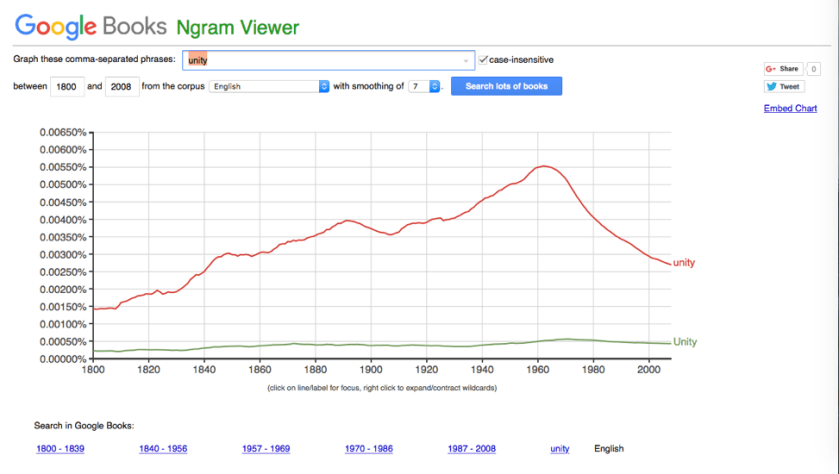
Take a look at this trend analysis found by doing a word definition search on Google.com for the word “unity.” Notice the steep decline starting in the 1960’s? Now, look at the diagram below that showing the shape increase in the use of the word “diversity” starting around the same time.
Trend1

Trend2

With those images in mind, think about America in the past 50 years. Has the nation become more unified and strong, or divided and weak? Is there more racial harmony because of all the diversity awareness classes and “look at what makes me different than you” celebrations?

No! We’re a nation at each other’s throats. Politicians are increasingly divisive. The people are increasingly divided and less tolerant. Instead of looking at each other and seeing a fellow American who bleeds red, white and blue, we see someone who is different and has competing interests. American flags are being lowered from college campus flagpoles because they don’t want to offend someone by being patriotic and proud of being an American. Many people no longer stand or put their hand over heart when they hear the Star Spangled Banner playing. A surprising number of college students have no idea what July 4th is all about, except an excuse to get drunk and watch fireworks.

America is just a place to live now. Nationalism faded away along with telephone booths and road maps, and maybe even before that. It used to mean something to be an American. It meant you were part of something greater than yourself. It meant you were part of the most successful, powerful, prosperous nation in the history of the world, and you were just as much of an American as the person standing next to you with a different shade of skin or social class. When times got tough, American’s pulled together and unity prevailed. What will happen now when things go downhill? What has happened?

Look at the recent Islamic-inspired terrorist attack in Orlando. Instead of rallying together, caring for the families of those hurt and killed, seeking justice and calling the Islamic terrorist for what he was, fingers started pointing in all different directions. “Gun owners and the NRA are at fault,” “Homophobic Christians are at fault,” “Republicans are at fault.” Everyone is at fault except for the guy who pulled the trigger and those who perverted his mind with radical Islamic ideology. The moment the shell casings hit the floor, we were a divided nation.

What happened after this tragic attack in Orlando is only a foretaste of what’s to come in this country until and unless we can stop myopically focusing on what makes us different, and start embracing and emphasizing what unifies us – starting with the fact we’re all humans made with intrinsic value and worth endowed by our creator.

The Declaration of Independence contains these words: “We hold these truths to be self-evident, that all men are created equal, that they are endowed by their Creator with certain unalienable Rights, that among these are Life, Liberty and the pursuit of Happiness.”

That’s a great place to start. From there, we can move on to things like the common struggles, hopes and dreams of human existence, then our commonalities as Americans, and so on.

E Pluribus Unum – Out of Many, One – the great motto of these United States. Let’s not allow it to become “E Pluribus Pluribus” – Out of Many, Many. It has long been said and remains true – united we stand, divided we fall.

Thoughts on Prayer – Part 2

By David A. Liapis

…Continued from earlier.

Another way we go wrong when it comes to prayer is when we view it solely as a means to an end. Now, prayer certainly can be a means that accomplishes an end in that we pray with an expectation God will hear and answer. But when seeking an answer or drawing closer to God though prayer as a spiritual discipline, both of which are good and Biblical reasons to pray, becomes the default all the time, we’re missing something. That something is what Jesus taught us by His example of prayer. He is God. When He was here, did He really have the same kinds of needs we do? In His humanity, some. Did He need to confess sin and seek reconciliation as we so often do? No. I would argue that much of the time Jesus spent in prayer with His Father was Jesus just “being” with the Father. Prayer for us needs to be an end, not just a means. Sometimes we just need to be with God. Be honest with Him. Talk to Him like a child to a Father. Don’t ask for anything. Don’t pray for anyone. Just share what’s on your heart and then listen. Be still and learn to hear the voice of God. It’s hard! I know. I’ve tried, and I usually last about five minutes.

So, why we should pray for others, and what power does prayer truly possess? I mentioned already that I think prayer serves two main functions – to humble us and conform our will to God’s will – but there are some others as well. As it relates to others, I think it really matters. When we tell someone we’re praying for them, it’s a lot more encouraging than saying “I’ll be thinking about you.” What does my thinking about someone’s problem really do other than maybe make them feel good knowing they are cared for? But to be interceding on their behalf to the God of the Universe? That’s a different story. But, what happens when I pray for someone and the prayer seems unanswered or not answered in the way we wanted? Did my prayer fail? Does God not care? Is God unable to answer? I’d argue that sometimes we don’t tell people we’ll pray for them because we’re afraid.

James sheds some light on that when he says that we should say, “If the Lord wills we will do this or that.” Is that a lack of faith to give God, and prayer, an “out” if things don’t go our way? I say no. It’s wise and Biblical to pray “If the Lord wills” or “Not my will, but thine be done.” What we have to do is set expectations and frame the narrative of our offer of prayer by saying that we’ll pray specifically for such and such a thing, but that we’ll also pray for the strength and grace to accept God’s will, whatever it may be. That’s not a faithless prayer, as some might contend. Rather, it’s a prayer that acknowledges that just because God can, does not mean He will. Only He knows His ultimate plan and what’s best for us, even when it includes suffering. We should pray that people will see the purpose behind the suffering, or at least learn to trust that God has a reason and a plan. If we can’t trust in the goodness and sovereignty of God, we’re hopeless and prayer is more than a waste of time – it’s a cruel joke. But, since God is both good and sovereign, the deficiency is always with us and our lack of faith and/or understanding of the situation.

It really comes down to faith. The Bible says to pray, so we do. The Bible says there is power in prayer, so we believe it. The Bible tells us/shows us to pray for others, so we do. The Bible tells us God hears our prayers, but that sometimes they are not answered in the way or in the time we want for a variety of reasons (Daniel and Zechariah). When we pray for something and it happens, we are reminded and encouraged that God hears and answers and our faith is strengthened. When we pray and don’t get the answer we want, our faith is challenged; but if we persevere even when it doesn’t make sense, our faith is strengthened. When we hear someone has been praying for us, we are reminded of the love and unity we share in Christ and our faith is strengthened.

The bottom line is that no matter what happens when we pray, our faith can be strengthened if we have the right perspective. It’s really hard to have that perspective sometimes, especially in times of intense pain and suffering; but that’s when we need to pray and pour our hearts out to the Lord that much more. It’s impossible for an unbeliever to understand any of this because it takes spiritual eyes to see the purpose and power of prayer.

I know I didn’t give a “nailed it!” answer, and I don’t know if we’ll ever find one this side of heaven. I still don’t fully understand prayer, nor do most people. If someone has figured it out completely and written a book about it, I have not heard of it. The fact there are so many books and opinions on the topic shows that it’s fraught with difficulty, so be encouraged if you struggle with prayer. You’re not alone in your quest to grasp the meaning of this thing we’re taught to do as a primary spiritual discipline.

Thoughts on Prayer – Part 1

By David A. Liapis

Any Christian who’s really honest with themselves has asked, or is still asking, the question “why pray?” A study of the subject will reveal thousands of books, commentaries and opinions about prayer, and it seems no matter how much one reads or may see the logic in an argument, it’s still hard to reconcile it in one’s own mind; and it’s even harder to communicate what squishy conclusions are drawn, if any.

My mom left this world for real life a little more than two years ago. What was harder for me to reconcile was not just her death, but her death in light of her life. Why did God let her suffer so much and for so long (like 18 years) with a lung disease that eventually had her struggling for the breath to even walk around the house? She was so faithful to Him – spending time reading, praying and journaling for hours every day, serving until she physically couldn’t in various ministries, etc. She was a model Christian, and yet God let her suffer and never healed her in spite of many prayers from her and all of us. I have wrestled with many questions related to prayer, and her passing certainly prompted more.

I have come to the conclusion that prayer serves two main purposes (I’m definitely not the first to say this). First, prayer humbles us. Through prayer, we acknowledge our needy, helpless position before God (supplication), we acknowledge His greatness and our depravity (worship, adoration), and we serve others by spending our time and energy on them (intercession). Proud people don’t pray. Humble, loving people open their apertures and think about others and their needs long and often enough to devote time in prayer for them.

The second thing prayer does is that it’s a bending of the will. But, whose will is being bent? It often becomes our attempt to bend God’s will ours. We have so many things we want, and we think we know what’s best for us and for others. However, God uses prayer to bend our will to His. This takes humility and a willingness to be wrong about what we think is best as well as a willingness to not know or understand why God’s will is what it is or why His timing is not in line with ours.

Zechariah, the father of John the Baptist, is a good example. When Gabriel visited him in the temple, he said, “Your prayers have been heard…” I don’t know about you, but I suspect Zechariah had probably not prayed for a child for a long time, maybe like 20 years. It’s speculation, but I base it on what we know of his age as well as his response to the angel’s message – doubt. He couldn’t see how it was possible for him, or his wife whom he said was “advanced in years,” to have a child. If he was still praying for a child at that point, it must have been a faithless prayer. I prefer to believe he had prayed that prayer many, many times … up to a point – the point he thought it no longer possible for his prayer to be answered. However, God was going to answer, but in His time.

Another example I look at is Jesus in the Garden of Gethsemane. Even Jesus prayed for the plan to change if possible, but was willing to submit Himself to the Father’s will – which included being crushed under the holy wrath of the Father for our sins. When Jesus taught His disciples to pray, He instructed them to say, “Thy will be done on earth as it is in heaven.” Ultimately, the example is to express our desire for God’s will to be done, which it will undoubtedly be, in a way that implicitly or explicitly bends our will to His no matter how much or little we understand or like it.

Psalm 37:4 says that when we delight ourselves in the Lord, He gives us the desires of our heart. But what does that really mean? That God will give me what I want? No. Rather it means God will give me the desires He wants me to have. What I want will become what He wants when I delight in Him.

To be continued…

Resignation vs. Joyful Submission

By David A. Liapis

“Inshallah.” During my time living in Turkey I heard this word, meaning “if Allah wills,” or “as Allah wills it,” uttered casually hundreds of times by many Turks in an array of circumstances. Although it seemed to be largely a colloquial expression (think, “stuff happens” or “let’s hope so”) more than an actual faith-based assertion, it was still telling of the attitude the Turks had towards the concept of divine intervention, fate, chance or whatever one might call it. At the core it was a cognitive resignation to the events and circumstances outside the control of the individual, much like when Christians say, “if the Lord wills it” or “it was the Lord’s will.”

I have found in my own life that I am disposed to acquiescing to God’s will in a very casual, non-faith-based way. I’m of the Calvinist persuasion theologically and, therefore, have a high view of God’s sovereignty and His providential control over all things. I get it, I accept it, and I “roll” with it. It helps me to make sense of the world I live in regardless of the goodness or badness of any given situation. Yet, in spite of the far-reaching realities of what I believe and the effect such beliefs should have on me, I too often find that my attitude toward God’s sovereign will is more of resignation than of joy.

I believe there is one major contributing factor – prayerlessness. Philip Ryken said, “In prayer we surrender our will to God’s will. Prayer is not a way of getting God to do what we want him to do; rather, it is a way of submitting to God’s will in all things.” (Ryken, 2003, p. 19) If our will is not in conformity God’s, then God’s will will often be contrary to what we desire and long for. This, of course, results in joyless resignation rather than joyful agreement. We go along with God’s will, sometimes grudgingly, because we know we can’t thwart it and we might as well not “kick against the goads” and resist it. I can say from personal experience that this is not a pleasant place to live.

This type of mindset can lead to many dangerous things in a Christian’s life – legalism, ineffectiveness in evangelism because of a lack of joy, fatalism leading to spiritual and evangelical paralysis and more. However, the antithesis to this resigned submission to God’s will is to receive with joy all things because we believe and trust the promises of Romans 8:28-30. It’s certainly possible to believe “all things work together for good” as a resigned believer. I have done it for many years. However, there’s no joy in it.

Imagine Eeyore the donkey saying, “Well, I guess I just have to believe this will work out for my good since God said it would,” versus Joy, from the movie Inside Out, saying, “This is totally going to be awesome because God is in control and this is His will!” Both ways of thinking assert faith in the promises of God, both trust that God’s will is best and will ultimately lead to “good” for the Christian, but the difference is in the attitude; and, I would argue that the attitude we have toward God’s will is primarily affected by the health of our prayer life.

John Piper once said in a sermon,

One of the clearest demonstrations that the pursuit of our joy and the pursuit of God’s glory are meant to be one and the same pursuit is the teaching of Jesus on prayer in the gospel of John. The two key sayings are John 14:13 and 16:24. The one shows that prayer is the pursuit of God’s glory. The other shows that prayer is the pursuit of our joy. In John 14:13 Jesus says, “Whatever you ask in my name, I will do it, that the Father may be glorified in the Son.” In John 16:24 he says, “Hitherto you have asked nothing in my name; ask, and you will receive, that your joy may be full.” The chief end of man is to glorify God and enjoy him forever. And the chief act of man by which the unity of these two goals is preserved is prayer. Therefore, Christian Hedonists who pursue in God’s glory the fullness of their own joy will above all be people of prayer. Just like the thirsty deer buckles down to drink at the brook, so the characteristic posture of the Christian Hedonist is on his knees. (Piper, 1983)

I write this as a “resigned believer” who is in great need of a reformed and revitalized prayer life. I write this as a way or remembrance of what I believe the Lord has revealed to me today as well as a means of hopefully encouraging any other “resigned believers” out there who long for the “joy of our salvation” to be restored.