
From Summer Camp Sampling to Savoring the Savior

I grew up in California, and every summer my church would bus us up to Hume Lake Christian Camps where we would spend a week experiencing summer camp things: games, chow hall food, staying up way too late, a cool worship band playing Shout to the Lord (this was the 1990’s, after all), and a guest speaker who did his best to entertain and educate us from the Bible. Every week was the same no matter which camp you were in – Sunday was pepperoni pizza night, Tuesday was “Come to Jesus” night, Thursday was “Come back to Jesus” night, and Friday night was BBQ on the lawn. What was also as predictable as summer camp romances and exhausted camp counselors was that many of the decisions to follow Christ for the first time, or with more devotion, would last until these new “converts” or “rededicators” stepped of the bus back at home. 

I witnessed this many times, and even experienced it personally. I went to Hume Lake from the time I was 11 until I was 15 before the Lord graciously laid hold of me on a Thursday night in 1998 at Ponderosa Chapel. That night, on which I thought I was “rededicating my life to Christ” since I had made a profession of faith and was even baptized years earlier (but which I later came to understand was actually my conversion) and all my “summer camp sampling” of Jesus and His Gospel became so much more. All the years I spent “tasting and seeing” prior had led to nothing because the Holy Spirit had not yet given me a heart of flesh and opened my eyes to see that the Lord is indeed good. No amount of mountain top experiences at summer camp or attending church with my family saved me. It was the irresistible, irreversible and irrevocable work of God to move me from the kingdom of darkness into the Kingdom of His beloved Son. 

Christian camps are all too often viewed as either “the” place to send our lost kids to get them saved, or as total scams because of all the false professions and emotional manipulation that takes place at many of them. I won’t deny that even at good camps (like Hume Lake) emotions run high, Jesus-hype takes hold, and easy “altar calls” (i.e., “with everyone’s head bowed and every eye closed, just slip up your hand quickly if you want to make a decision to follow Jesus”), and many of the “conversion” numbers the camps tout to parents and financial supporters are far, far lower in reality. Then, bad theology at many churches these kids return to serves to give these new “Christians” and their parents a false sense of security, and years of struggle and doubt as many of the kids continue to live like the world in spite of the fact they raised their hand prayed the sinner’s prayer and maybe even filled out the ever-important decision card. 

It may sound at this point like I am anti-Christian camp. After all the emotionalism and even deception (such as speakers saying “I see that hand” when no one was raising their hands, just to “encourage” reluctant young people to signify their desire in the moment to commit to following Jesus) I have personally experienced and witnessed while working at Hume Lake for three years, this would not be a hard position to support. However…

The problem isn’t Christian camps. The problem is our expectations. Do the lost hear of Jesus and the Gospel for the first time and get saved at camp? Absolutely. Do churched, but unsaved kids come back from camp spiritually alive and no longer living a double life? Undoubtedly (this was my own experience, as I have shared). Do many kids go to camp and make false professions of faith for any variety of reasons? Sadly, yes. So, rather than viewing camp as a necessary piece of every salvation story, or as a place to keep our kids from attending for all the negative points, we should view it as part of a varied diet of which it should only be one part. 

As we raise our children, they are being fed at home, at church, at school, at their friends’ houses, and at places like summer camp. It’s our responsibility to ensure their diet is healthy and that in all these contexts they are “sampling Jesus” through the both the direct teaching of His Word, and through the examples of the people around them. Hopefully, as our children grow, whether they are saved yet or not, they are sampling from the buffet of biblical truth that comes from the pulpit, from family worship, from personal reading of Scripture, from music, from youth group, and from unique “pinnacle events” like conferences and camps. 

Thus, a realistic expectation of camp tempers our expectations (though our hopes and prayers should be soaring!) since it’s only one item on the buffet as our children see and savor Jesus Christ. If they come back from camp and have fully and truly tasted and seen the goodness of the Lord, praise God! If they come back and tumble back down the mountain, then keep praying, keep feeding them, and keep trusting them to the Lord. 

The years I spent attending, and then working at Hume Lake (to include being saved and finding my wife and marrying her on the lawn there that overlooks the lake and majestic Kings’ Canyon) were some of the most spiritually formative, fun and fulfilling years of my life. Now, many years later and as a parent of five kids, I have had to decide whether or not to allow them to attend various camps. Most of the time the answer has been “yes,” but always with the tempered expectation that the pathway to each of them moving from “summer camp sampling” to savoring the Savior is fully dependent on the unmerited grace of God, not on how good a camp’s program, music or speaker is, or how high the mountain top experience. Let’s remember that camp should only be viewed as one dish in the buffet of spiritual food, and that the Lord can lay hold of our children anywhere and at any time He pleases. 

Seeds, weeds and evil deeds

Thoughts on Matthew 13:24-30 and 36-40

The percentage of Americans working in agriculture over the last 200 years has decreased from approximately 75 percent to less than two percent. Why is this statistic relevant? Because about 75 percent of the parables Jesus told related to agricultural themes, and our current general lack of understanding of agriculture can limit our understanding of, and therefore the impact of, these teachings. What we have to apply more thought to today would have been much more easily comprehended by the original audience, as well as by more Americans before the early 20th Century. Jesus’ discussion of seeds and weeds and evil deeds likely resonated more with those who listened to the Word of God with soil-stained fingers. So, what can we learn today from parables like the ones from Matthew 13:24-30 and 36-43 about the “Wheat and the Tares”? The most prominent answer is a fancy theological word. 

Eschatology is “the part of theology concerned with death, judgment, and the final destiny of the soul and of humankind,” according to the Google dictionary. What’s interesting about this parable is that it highlights the “already, but not yet” reality of the Kingdom of Heaven, describing the Kingdom in the present as well as the future. Jesus said many times while He walked around Judea that “the Kingdom of Heaven is at hand,” meaning that the Kingdom had come upon this world when Jesus came – though not an earthly kingdom like the one the Jews expected, but rather a spiritual kingdom that broke into the reality of this world through miracles, the Word of God, and the very presence of God in the person of Jesus Christ who, as we know, defeated sin and death by His sacrifice for us on the cross and His resurrection three days later. The Kingdom has indeed come in many ways, but it will also come in fulness at the end of the age.

While the primary message of this parable is as encouraging as it is simple – that the sons of the devil will be punished and the sons of the Kingdom will “shine like the sun in the kingdom of their Father” as explained by Jesus in verses 36-43, we can also get lost in the weeds (see what I did there?) of theological debates on the chronology of end times events. 

Some Christians believe that there is a “Rapture” in which Jesus will secretly return and gather the Church before a seven-year period of immense trouble called the “Tribulation,” after which Jesus will come back visibly and establish an earthly kingdom for a literal 1000 years, and then after that He will judge the world and cast Satan and all unbelievers into the Lake of Fire. Other Christians believe that the 1000 year reign of Christ is symbolic and happening right now, and that Jesus will come back at the end of the age and resurrect both good and evil people to face the final judgement. There are other views as well, and many books, articles, blogs and more comments than can be counted have articulated them, so there is no need to even attempt to do that here. The encouragement here is to read this parable and the other passages about the end of the age to learn the most important thing: that Jesus is indeed coming back to judge the world. 

So, what can we take from this passage as it relates to agriculture and our lives? Well, what does the man who owns the field do when he is told there are weeds growing along side the wheat? He wisely tells his workers to let them grow together until the harvest so as not to harm the wheat. This brings to mind Jesus’ prayer in John 17:15 where He says, “I do not ask that you take them out of the world, but that you keep them from the evil one” (if you have not read Jesus’ prayer for His disciples [and you] recently, you should stop now and do that). This parable also serves to remind us of verses like Psalm 92:7, “…that though the wicked sprout like grass and all evildoers flourish, they are doomed to destruction forever…” and Psalm 37:7, “Be still before the LORD and wait patiently for him; fret not yourself over the one who prospers in his way, over the man who carries out evil devices!”

Finally, perhaps the biggest takeaway from the parable of the Wheat and Tares should be to know what you are – a stalk of wheat that will be gathered and put in the Jesus’ barn, or a weed that will be plucked up and thrown into the fire? The miracle of redemption is that God can turn a weed into wheat, an enemy into a son or daughter, a sinner into a saint. This parable is a warning to unbelievers that the end of the age is coming, and judgement with it; and an encouragement to God’s children that one day “all causes of sin and all law-breakers” will be taken away, and the “righteous” will rejoice forever in the presence of their Father. 

Bigger isn’t always better

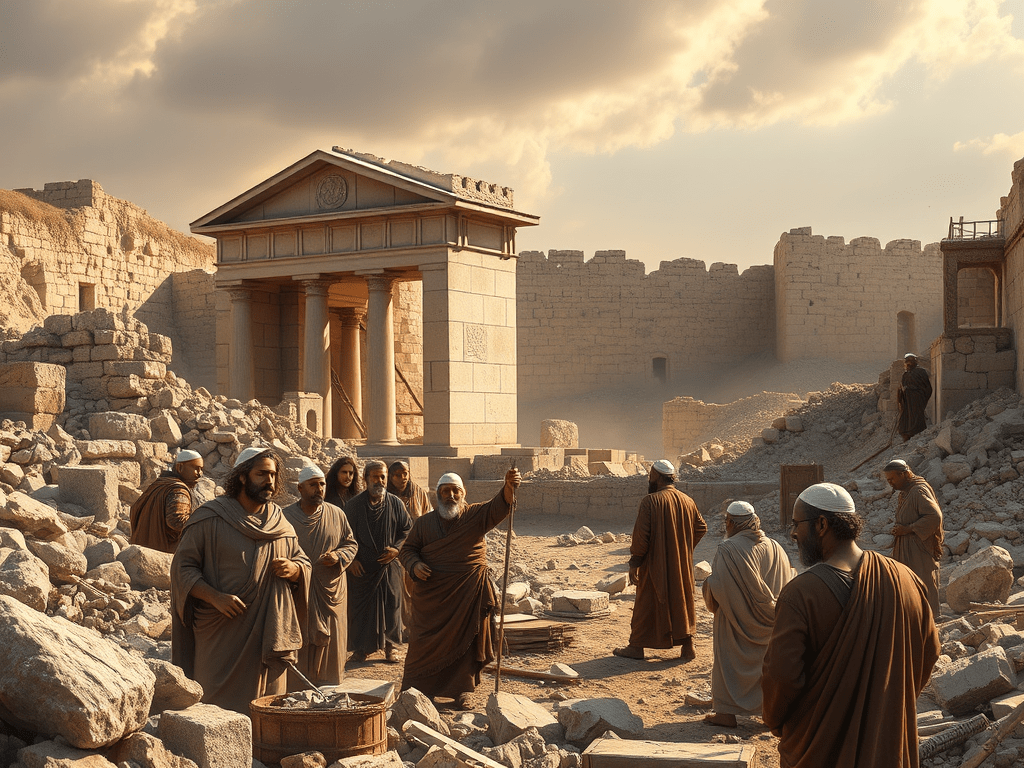
This passage reflects on the struggles of the Jewish exiles as they returned to Jerusalem to rebuild the temple after 70 years in captivity. Despite the new temple’s inferiority compared to Solomon’s, God reassures His people of His presence and strength. Their courage and work are rooted in the promise that God is always with them, emphasizing that true glory lies in this divine relationship rather than in grandeur.

It was an uncertain, dangerous and discouraging time for the people of God. More than 70 years had passed since Judah was taken captive into Babylon and the city of Jerusalem –  including the temple – had been destroyed. After surviving multiple regime changes and oppression in captivity, King Cyrus finally allowed the Jewish exiles to return to rebuild Jerusalem; and during the reign of Darius the Mede the Jews laid the foundation of a new temple.

After a few years and the Jews had finished rebuilding their homes, the temple project was left undone. Haggai the prophet was then sent by God to command the people to actually get about the business of rebuilding of the temple, which they did. However, this new temple was inferior in size and grandeur to the one Solomon built, a fact which the Lord even points out in Haggai 2:3, where He says through Haggai to the people, “Who is left among you who saw this house in its former glory? How do you see it now? Is it not as nothing in your eyes?” This seems like a discouraging word from God as the people labored to build a place to worship Him. Why this seeming insult? 

The Lord was not trying to crush the spirits of His people and belittle their work. Rather, He was making a point in these verses that we all would do well to hear. Right after the Lord asks the rhetorical questions in verse three, He immediately follows it up with command that’s also an encouragement – and one that harkens back to the words spoken many hundreds of years earlier to Joshua as he was about to lead the people of God into the Promised Land – “be strong and courageous.” Now, after Israel and Judah had suffered greatly at the hands of the Assyrians and Babylonians because of their disobedience, God again commands His chosen people to “Be strong, all you people of the land, declares the Lord.” But, God doesn’t stop there with a hearty, “You’ve got this!” There’s something else that’s an absolute necessity in order for the people to “be strong.” 

Why can and should the leaders and people be strong and continue working on an inferior structure? The Lord continues, “Work, for I am with you, declares the Lord of Hosts, according to the covenant that I made with you when you came out of Egypt.” Thus, in spite of the current temple being “nothing” compared to the glory of Solomon’s Temple, the covenant-keeping God is saying that His presence – which is true glory that far outshines any temple made with hands – is not only there with them, but that His presence is not dependent on having a majestic temple like that of Solomon’s. Rather, His presence with them – or anyone else – is His divine prerogative to be their God, and for them to be His people. 

Thus, the reason why the people of God who were rebuilding the temple could be strong, and the reason why Joshua and the Children of Israel could be strong and courageous is for the very same reason. The famous verse in Joshua 1:9 does’t end with the command, it ends with the promise “…for the Lord your God is with you wherever you go,” just as Haggai 2:5 ends with, “My spirit remains in your midst. Fear not.” In the same way, Jesus declared to his doubting and anxious disciples as He was commissioning them to go into all the nations to teach and make disciples at the end of Matthew’s Gospel, “And behold, I am with you always, to the end of the age.”

There are two main points to take away from all this today. The first is that we can be strong and unafraid because the Lord is with us. There are so many verses that speak to this truth that I cannot list them all here, but a few are: 

– Romans 8:31b: “If God is for us, who can be against us?”

– Zephaniah 3:17: “The Lord your God is in your midst, a mighty one who will save; He will rejoice over you with gladness; He will quiet you by His love; He will exult over you with loud singing.” (emphases mine)

– Isaiah 41:10: “Fear not, for I am with you; be not dismayed, for I am your God; I will strengthen you, I will help you, I will uphold you with my righteous right hand.” (emphases mine)

God – who is our ever-present help in time of need – is with His people. We don’t have to ask for Him to be present with us, because He has promised to never leave us or forsake us. Furthermore, we don’t have to strive harder in order to bring about more fulness of His presence. 

The second point is exactly that – that God’s presence is not dependent on if we’re in a massive church with elaborate stained glass windows and a full pipe organ and 40 foot cross that you can see from the third balcony, or setting up and tearing down each Sunday in an elementary school gym. God is present with His people because His Holy Spirit dwells within us! This is why Jesus said with such confidence that it was better that He “went away” back into heaven so that the Holy Spirit would come. If we are sons and daughters of God, adopted into His family and sealed with Spirit that enables us to cry out “Abba! Father!” as Paul says in Romans 8:15, then we can rest in the assurance, hope, joy and strength conferred by our status as the Children of God. His presence is with us, and the measure of faith He has given us and the good works He has prepared for us to do are His to give and ours to receive and participate in.

Thus, it doesn’t matter if we build Solomon’s temple or the inferior post-exile temple. It doesn’t matter if we are called to the mission field of China or our suburban home. It does’t matter if we serve in a church of 5000 or 50. The point is that the greatness of our all we are and do is founded in the surpassing greatness of the God who calls and enables us to be and do anything. Jesus said, “Whoever abides in me, and I in him, he it is that bears much fruit, for apart from me you can do nothing.” (John 15:5b) 

Do you want to experience the presence of God? Do you want to do great things for the Kingdom? Then the real question is this: Are we abiding in Him? James 4:8 says, “Draw near to God, and will draw near to you.” Are we content to sit as Jesus’ feet and stop worrying about the size of the temple we’re trying to build? Is the “good portion, which will not be taken away” enough to satisfy us? I believe if we taste and see that it is, we will be able to work in strength and joy, for He is with us.

The art of giving

Is it really better to give than receive? What do the Bible and history teach us?

Examples of the generous giving of resources – such as time, talents, money, homes (for the gathering of Christians or housing of “strangers and sojourners”) – for the worship of God, the spread of the Gospel and caring for people is all over the Bible, and we have the privilege of being a part of that ongoing legacy in a variety of ways. 

However, for many people, the first thing that comes to mind when the topic of giving in church is brought up is a metal or wooden plate, or maybe a velvety felt bag with wooden handles being shoved in their face as the pastor or an elder elucidate the importance of giving until it hurts and how, as Americans, we have so much comparative wealth; and, this recollection often elicits feelings of guilt or anger, or even distrust in the people/organization they are giving to, or distrust in God to “keep His end of the deal” with financial blessings. There’s also, I believe, a widely-held misconception that the amount we give must be a hard and fast 10 percent every month of the year, every year, until our eulogy is read. 

While faithful, predictable giving is certainly helpful to a church when it comes to setting an annual budget (which allows for paying and hiring staff, purchasing equipment and consumables, paying rent or a mortgage, funding other ministries, etc.), that “sustained” giving is not the only way we can give. Another way is “specific” giving, such as when there’s a particular need brought up – like a building fund, a sound equipment refresh or a functioning TV for the kids’ ministry. This type of giving can be in addition to sustained giving, but it can also be a way for people who don’t give on the regular to help meet a clear need. 

Sustained giving is probably the most common (and helpful) way to see your local church thrive, but there are pitfalls to avoid. If your “tithing” has become so automatic that you don’t even think about it anymore – rather, it’s just a line item in your personal budget like your internet or cell phone bills – or if you’re doing it grudgingly, then it’s probably not even healthy for your soul or truly an act of worship. Similarly, specific or sporadic giving is great to meet tangible needs and help train our hearts to hear and obey the prompting of the Lord, but we have to be sure it’s coming from a heart of worship and not from coercion – either you being guilted into emptying your wallet, or trying to force God to rain money down on you from heaven because you “sowed a seed of faith.” As God’s Word says in 1 Corinthians 9:7, “Each one must give as he has decided in his heart, not reluctantly or under compulsion, for God loves a cheerful giver.”

Some people have taken this verse as a “get out of giving” card in that they claim they cannot ever give because it would not be done with a right heart, or that God has never prompted them to do so. We have to see though that the Apostle Paul, when writing to the church in Corinth, said “Each one must give…” The implication is that Christians will all give, but it can look different for each of us “as we have decided in our hearts,” and it needs to be done with joy and willingness.

As with many aspects of our Christian faith, doctrine and theology, there’s a good middle road that’s sometimes hard to stay on, and we are at risk of falling into a legalistic or liberal ditch on either side. This is true of giving in that we can look at verses such as Malachi 3:6-12 (testing God by giving, and then Him pouring down blessings from heaven) and 1 Cor. 6:9 (sowing sparingly vs. bountifully) and come to an understanding that too closely resembles false “health, wealthy and prosperity” teaching. However, those verses are in the Bible, and there are many Christians out there, myself included, who have “put God to the test” in this way and, over time and are walking in what we believe to be obedience to Him, have seen God bless us in very real ways, including financial.

The point is this: the Bible is clear – Jesus Himself said, “It is more blessed to give than to receive,” and the giving of our “time, talents and treasure” is nothing short of an act of worship and obedience that trains our hearts to trust in and depend upon God. Finally, and practically, generous, sacrificial giving is the way in which the people of God have been able to conduct worship (from the times of Tabernacle to the present day), spread the Gospel, and care for widows, orphans and others in need for thousands of years. The question for us today is this: how are we being called to join them?

Stingy Sowers

The parable of the Sower emphasizes the importance of the Sower, who scatters seeds broadly, illustrating that Christians should share the Gospel generously without judging the potential of the soil. The focus is on God’s role in cultivating hearts, underscoring that it’s not our job to assess but to trust in His growth.

~ Thoughts on Matthew 13:1-23 ~

One of the main characters in the parable of the Sower and Seed is often overlooked despite his name being in the colloquial title of the parable! We often get so caught up in analyzing the different types of soils and arguing whether or not any kind of plant growth is indicative of “being saved,” or if “bearing fruit” is the only way to know for sure if someone is heaven-bound. However, this namesake character is by no means unimportant, and based on the text in Matthew 13:1-23, we can infer a number of key things about this person by his actions, and even by how he sows. 

The first thing to consider about this oft overlooked character is that he sows seed bountifully, broadly, and, some might even argue, carelessly. Look in the text at the way the Sower tosses seed all over the place, not just in a carefully prepared furrows as one would expect. If you were a first century Galilean with any understanding of agriculture (which many had), then you might have felt somewhat incredulous about the wastefulness of throwing seed on the hard pathway. Some sources state that in ancient times as much as 25 percent of a grain harvest was preserved as seed for the following year. So, why was the Sower was so careless about where the precious seeds fell? One possible conclusion is that the Sower is so wealthy that he can afford to scatter seeds all over the place – even where he does not expect to reap a harvest. 

I think the lesson here is that we should share the Gospel “bountifully, broadly, and … carelessly.” Not careless in the sense that we are unwise or unloving in our approach to people or reckless with the message, but careless in the sense that we don’t withhold “sowing” seed on soil where we think there is no hope of a bountiful harvest, or even growth at all. The reality is, we’re not God and thus don’t know what (or, rather, who) is “good soil” or not. One only has to consider how plants (including what we would consider “weeds”) can grow in the most inhospitable places – sidewalk cracks, mountain crevasses, gutters, and seemingly every other place we don’t want green things to grow – and yet so often our efforts to cultivate thriving plants in what we deem “good soil” fail miserably. This is such a great illustration of how it’s God who causes the seed of the Gospel to take root, grow up into a mature plant, and bear fruit in someone’s life. 

The point of this parable is not that we need to somehow discover what kind of soil we are, and, if we determine we’re not good soil, to then amend ourselves into tilled and cultivated ground so we can receive the Gospel. Think of how impossible that is for dirt to do for itself, and then realize that it’s only God who can break up hard ground, uproot thorns and thistles and turn barren land into a fruitful garden. Jesus says as much in the verses sandwiched between the parable of the Sower (vv1-9) and its explanation (vv18-23). Here in verses 10-17 Jesus makes it clear that God is the one who sovereignly chooses to open ears and eyes and grant understanding of the truth that leads to salvation. 

So, going back to the namesake character. Most of my life I have correlated the Sower to God; but I think I have been wrong all these years. I think we, individual Christians, are the Sower, and that our calling is to freely sow the seed of the Gospel with everyone (freely we have received, so we should freely give – Matthew 10:8). Our job isn’t to do soil analysis and cautiously and sparingly plant a seed here and there in what we determine to be rich soil. Rather, we should cast the seed far and wide and trust in the One who gives the increase with the results (see 1 Corinthians 3:6-9).

Jesus knows

What does it mean to “know” someone or something? Have you ever thought about the word “know” and how our modern use of it has become lazy and overly broad? Let me explain what I mean by that. 

If someone were to ask me, “Hey, do you know the song ‘Africa’ by Toto?” I’d answer, “Sure, I know that song. It’s like, “….something something something … down in Africa.” Now, I can certainly recognize a few aspects of the song – its intro, melody, the singers voice – but my “knowing” of the song is limited more to recognition or awareness. I can’t recite more lyrics than I did above; I don’t know when it was written, or what it’s even about. Sure, I could look all that info up on Wikipedia and work to memorize all the lyrics and melody so I can belt it out on karaoke night, but to be perfectly honest, I don’t want to take the time to do all that. 

It’s exactly that lack of caring that is the difference between “knowing” and “knowing.” We have robbed the meaning of the word “know” of a critical aspect by using it almost exclusively as a synonym for “aware.” Think about it for a moment. How often do you simply mean “I’m aware” when you say “I know”? Futhermore, how many times do we even say “I know” dismissively, like when someone informs you of something that you’re aware of, but don’t care about? We would be better off, I think, if we stopped using “I know” when what we really mean is “I’m aware.”

Why am I saying all this? Because I’m concerned that our misuse of “know” can cause misunderstanding of how Jesus relates to us. It’s true that Jesus, being fully God, is omniscient (He knows all things), but when we think about Jesus knowing us and our thoughts, words, deeds and needs, we often settle for Him simply being aware of them, but not caring about them. This is the real difference and why it’s so important not to diminish the meaning of the word. To truly “know” is at the very least to be both aware and to care. This fuller meaning of the word matters a lot when we contemplate how Jesus relates to us. 

In the second and third chapters of the book of Revelation, Jesus commands John the Apostle to write letters to seven churches that existed in the first century in what is now western Turkey. While each letter contains specific commendations, warnings and encouragements for each individual church, there is a common refrain that ties them all together – Jesus says to each of them “I know…” He knows their suffering, their needs, their sins, their future; and it’s not just an aloof awareness of those things, Jesus cares about them. He cares deeply about His Church, His bride, and just as he cared for those seven churches 2000 years ago, He is aware and cares about His Church today. Let’s take that a step further and acknowledge that Jesus is aware and cares about every one of His children who comprise the Church. He knows us – our thoughts, words deeds and needs. 

What does this mean for us practically? 

With regard to our sinful thoughts, words and deeds, Jesus has proven He is aware and cares by coming to die on the cross for our sins so we don’t have to. He has proven He is aware and cares because His Holy Spirit has come to convict us of sin and empower us to live obediently “in the Spirit” so that our thoughts, words and deeds are pleasing to Him.

With regard to our needs – including suffering and pain – Jesus proves He is aware and cares because He has both given us the Holy Spirit, the Comforter, and has established His Church – the family and people of God – who are called to support, comfort and love one another. Jesus proves He is aware and cares because He has given us His Word, the Bible, to teach, correct, encourage and equip us to live hope and joy-filled lives in the midst of trials and tribulations as we await the promised return of our Lord and Savior with whom we get to spend eternity because He has reconciled us to Himself through His blood. 

Finally, may we all “know” – be aware and care – that “Jesus knows,” and live accordingly in gratitude, love and obedience. 

Can you count the stars?

It must have been a clear night, and the desert air was likely rapidly cooling as darkness overtook the land. The dirt in the valley of the Dead Sea (as it was later called) was still stained with the blood of a massive regional battle between nine armies, and Abram the Hebrew had just successfully completed a subsequent smaller raid/rescue mission. Now, Abram, spoke in a vision with Yahweh – “God Most High, Possessor of heaven and earth” (Gen 14:22). God told Abram, “Fear not … I am your shield; your reward shall be very great.” This was indeed a great encouragement, and was certainly affirmed by the mighty victory God had just enabled and by the fact Abram trusted in God to protect and provide for him. However, Abram’s hope for greatness was not based in earthly riches or a military victory, but in the promise he had received years earlier from Yahweh himself that he, Abram the aged, would be the father of a great people through whom all of the earth would be blessed (Gen 12:3) and who would be as numerous and uncountable “as the dust of the earth” (Gen 13:16). However, his response to God reminding him that, “I am your shield; your reward shall be very great” on this particular night was more of a lament, or even a complaint. 

Abram replied to God in Genesis 15:2, “O, Lord God, what will you give me, for I continue childless..?” and then he went on in verse three, “Behold, you have given me no offspring…” It’s quite a bold indictment. Abram is both spurning his material blessings and (rightly) attributing his lack of a child directly to God, and is basically saying, “Because you have not given me a child, you’ve given me nothing.” Rather than strike Abram down for what appears to be disrespectful ingratitude, God reaffirms His promise to give Abram offspring so numerous that they cannot be counted – in spite of the fact he remained childless and he and his wife were elderly. In this reaffirmation of the promise, God tells his doubtful accuser to “Look toward heaven, and number the stars, if you are able to number them” (Gen 15:5). Of course we know from the next verse that Abram “…believed the Lord, and (the Lord) counted it to him as righteousness,” and that God kept His promise. 

It’s this idea of counting the stars that struck me recently. The first analogy God used of dust was clearly intended to convey that it would be more than an overwhelming task to actually count the number of Abram’s offspring, it would be impossible. For, even if you could somehow count every piece of dust (or grain of sand, as in another analogy God used with Abram), constant geologic and aeolian processes would cause more dust and sand to be created before the existing granules could be counted. However, the second analogy of the stars might have seemed to Abram as remotely possible, even though the Lord implied it was not. 

Think of Abram living in the middle east without a telescope or any other way of knowing that the number of stars just in our galaxy alone far surpasses what even the keenest-visioned person can count, or that some of what he could see shining on a clear night were actually planets and even another galaxy. What he didn’t know when God told him to “look toward heaven” was that the heavens expanded past the solar system and the Milky Way galaxy, and included millions of other galaxies containing billions upon billions of stars. Even if Abram was tempted for a moment to think he could meet God’s challenge of counting the stars, his lack of knowledge and ability would have led him to a calculation that was profoundly insufficient. What might for a moment have seemed like a possibility and answer what might have been a burning question for Abram – “Just how many offspring will I have?” –  was in reality a more daunting task than counting every grain of sand and piece of dust on Earth. 

I think that God’s challenge to Abram is meant to do more than just test his human ability to count the stars and be impressed and encouraged by what he sees. It seems that the most impressive and encouraging aspect of God’s challenge is actually what cannot be seen – the incomprehensible magnitude of the universe that Abram knew nothing about. In the same way, the promise God made to Abram was much, much more than just that he would have a whole lot of progeny. The magnitude of the promise – as we now know – is that Jesus Christ, the Savior of the world, would come from Abram’s bloodline and that the children of Abram (later Abraham) would be more than just physical, but spiritual as all who believe in Jesus Christ and the Gospel are children of Abraham “by faith.” 

I think God’s promises and providence are like that. It seems when God wills and acts the second, third and fourth-order effects (and so on) that ripple into eternity are good and awesome in ways we cannot fathom, and which we will get to spend eternity discovering, praising God more and more at each new bit of understanding and glimpse of God’s master plan. 

There are three encouragements I want to highlight for us today: 1. We can trust God’s promises and providence because history – and hopefully our own experiences – prove God is faithful. 2. “Look toward heaven,” consider that God is working in and through the good and enjoyable as well as the hard and sad in ways you cannot even think or imagine and trust Him “…who is able to do far more abundantly than all that we ask or think, according to the power at work within us” (Ephesians 3:20) 3. Finally, consider Romans 11:33-36. “Oh, the depth and riches and wisdom and knowledge of God! How unsearchable are His judgments and how inscrutable are His ways! ‘For who has known the mind of the Lord, or who has been His counselor? Or who has given a gift to Him that He might be repaid?’ For from Him and through Him and to Him are all things. To Him be glory forever. Amen.”

Failing for God

Have you ever failed? More specifically, have you ever put forth a lot time and energy into a project or task, only to have it utterly fail? 

In Luke 5:1-11 we read the story of Jesus calling his first disciples to follow him, and it’s a story that begins with failure – not in the sequence of verses, per se. If we place ourselves into the story and imagine the events that led up to the narrative in the text, we can infer that because Simon Peter and his fishing partners failed to catch any fish the night before, they were along the shore tending their nets instead of hawking fresh fish at the local market. As it was, because of their lack of fishing success, they were there as Jesus found himself pressed up against the water line by a crowd of people desiring to hear Him teach. They were there to row Jesus out on one of their boats so he could be heard and seen by more people. In this instance, their failure as fishermen put them in a position to serve Jesus and enable more people to hear the message of the Kingdom. 

Furthermore, I can imagine Simon sitting in the boat listening to the teaching of the man who had recently miraculously healed his mother-in-law. Was he fully engaged, hanging on to Jesus’ words, or was he distracted with the thoughts of how he and his coworkers would not have any income that day? Was he looking out at the Sea of Galilee wondering what they could have done differently to have ensured a better outcome? We may never know. But, what we do know is that he was reluctant to obey Jesus’ command to cast the net into the water once the teaching had concluded. “Master, we toiled all night and took nothing!” he countered. “But, at your word I will let down the nets.” Of course, we know what happened next – a record and net-breaking catch so impressive Peter fell to his knees and exclaimed, “Depart from me, for I am a sinful man, O Lord.”

Once the second boat and crew came out and helped Peter haul this massive catch to the shore, the text tells us they “left everything and followed him.” Left everything – including the most spectacular success of their lives. Hundreds, maybe thousands of fish left for people, birds and other critters to snatch up. Multiple days’ wages left as an offering on the altar of following Jesus. These fishermen went from utter failure to enormous earthly success to true, eternal success. 

What I want to highlight here is that this story depended on what was likely divinely-orchestrated failure in that seasoned fishermen who gave all they had to give and reaped nothing did so in order to gain everything. Their failure led them to be in just the right place to unexpectedly encounter and serve Jesus and others. Their failure presented an opportunity for Jesus to create an even greater contrast between their unfruitful toil and his abundant provision. Their failure led to a recognition of their weakness and God’s greatness. And, ultimately, their failure and then overwhelming success created an even more compelling display of commitment as they walked away from the best catch of their lives to, as Jesus put it, “become fishers of men.”

Maybe this resonates with you. Maybe you’ve experienced failure that God later used to teach, grow and lead you. Or, maybe you’re in the midst of that failure right now and need to be reminded that God’s good plan for you does not depend on your earthly success, and that it’s in our weakness and failures that God moves in powerful ways to show us His goodness, wisdom and faithfulness. Remember to promise of Romans 8:28-30, and remember the failure of three Galilean fishermen – Peter, James and John – whose stories and words are in the Bible to encourage and teach us today to trust in Jesus Christ to turn our failures into fulfillment of his promises and purposes. 

Photo Creator: Anry01 | Credit: Getty Images/iStockphoto